What do retail tenants actually expect from their landlord?
Uudised
•

Sisukord
Ole esimene kes kuuleb uutest projektidest ja uudistest
A short TL;DR first -

Ask a retail tenant what they want from their landlord and the answer is rarely exotic. They want the centre to work, they want to know what is going on, and they want their costs to be fair and explainable.
Tenant experience in a shopping centre is not an events calendar - it is operational reliability, delivered consistently.
That is good news, because operational reliability can be checked, measured and improved. Here is what retail tenants actually judge you on, organised as a checklist you can score yourself against.
Want to go deeper on this? Hausing's shopping centre tenant experience page breaks down the platform side of each item on this checklist.
What do retail tenants expect from centre management?
Four things, in roughly this order.
1. One clear way to report problems - and visible progress

A tenant with a leaking ceiling should not need to know which person to call.
There should be one channel where every issue lands, gets an ID and an owner, and where the tenant can see the status themselves without chasing.
The self-service part matters more than it sounds. Every "any update on our issue?" call is a small tax on both sides, and at shopping centre volume those calls add up to someone's whole job.
In Hausing, tenants report through their own portal and follow progress in real time; the property team assigns, tracks and closes the work orders in the same system, with contractors updating tasks through their own portal.
2. Fast resolution of anything that affects trading

Retail tenants distinguish sharply between inconvenience and lost revenue. A cosmetic defect can wait; a failed escalator on their customers' route cannot.
So sort incoming faults by one question: is this stopping a tenant from trading? If yes, fix it the same day. Tenants notice this speed, remember it, and reward it with a loyalty that no marketing campaign can buy.
The prerequisite is knowing your own numbers: response times, completion rates, overdue tasks. If you cannot measure resolution, you cannot promise it.
3. Fair, explainable shared costs

Service charges and utility allocations are where tenant trust is won or lost in retail property. The standard is simple: a documented allocation method, applied consistently, and explainable to any tenant from data within minutes.
We have written separately about fair utility cost allocation in shopping centres - it is the single most disputed cost area, and the most fixable.
4. Proactive communication
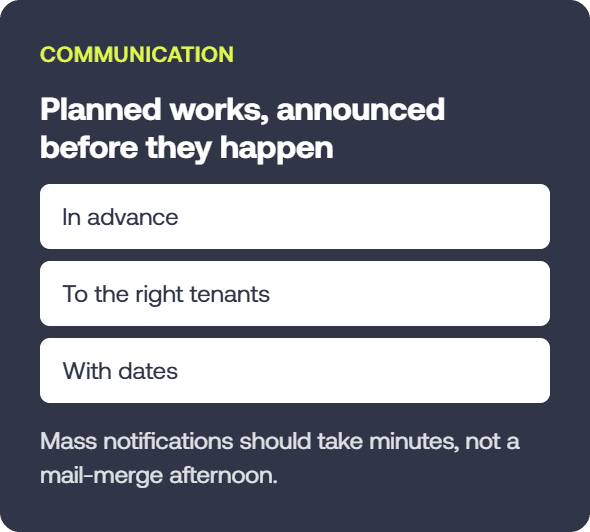
Planned works, disruptions, seasonal preparations - announced in advance, to the right tenants, with dates. Mass notifications to all tenants of a building or zone should take minutes, not a mail-merge afternoon. And recurring issues should visibly lead to change: a tenant who reports the same fault three times is learning that reporting is pointless.
How do you know where your centre stands?

Score yourself honestly. We have turned the four areas above into a structured checklist - fourteen items across communication, issue resolution, cost transparency and feedback, each scored Yes, Partly or No.
Two scoring notes from experience:
Anything scored "No" under issue resolution or cost transparency should be your first priority. Those are the areas tenants raise at renewal.
Re-score quarterly. Operational standards drift quietly; a quarterly check keeps the drift visible.
What if the gaps are systemic?

If your honest answers cluster around "we track this in email and spreadsheets", the gap is not effort - it is infrastructure. No team can deliver visible ticket statuses, measured resolution times and explainable cost allocations from an inbox.
That infrastructure is exactly what Hausing provides for multi-tenant commercial property, in one platform:
Work order management with tenant and contractor portals
Utility cost allocation
Mass tenant communication
Operational analytics
Across its customers, more than 6000 maintenance tickets are created each month, and 2,100+ buildings are managed in the system.
Download the free Shopping Centre Tenant Experience Checklist and score your centre this week.
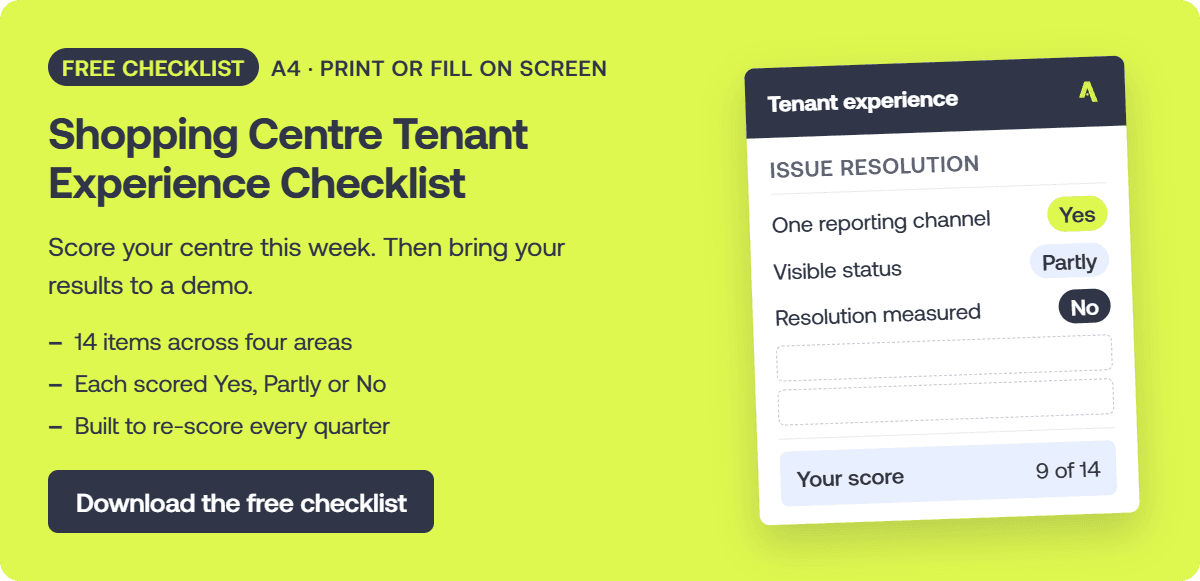
Scored it? Bring your results to a demo - we'll walk through how each "No" becomes a system feature rather than a resolution.
Selles artiklis leiad:
Retail tenants judge you on four operational things: one clear channel for reporting problems with visible progress, fast fixes for anything that affects trading, fair and explainable shared costs, and proactive communication. Score your centre against the checklist quarterly - and if the gaps cluster around email and spreadsheets, the problem is infrastructure, not effort
Your download is ready
Thanks — here’s the full document. It’s yours to keep and share internally.
Related insights


Oled valmis?
Too kõik töövood ühele platvormile
What do retail tenants actually expect from their landlord?
Uudised
•
Sisukord
Ole esimene kes kuuleb uutest projektidest ja uudistest
A short TL;DR first -
Ask a retail tenant what they want from their landlord and the answer is rarely exotic. They want the centre to work, they want to know what is going on, and they want their costs to be fair and explainable.
Tenant experience in a shopping centre is not an events calendar - it is operational reliability, delivered consistently.
That is good news, because operational reliability can be checked, measured and improved. Here is what retail tenants actually judge you on, organised as a checklist you can score yourself against.
Want to go deeper on this? Hausing's shopping centre tenant experience page breaks down the platform side of each item on this checklist.
What do retail tenants expect from centre management?
Four things, in roughly this order.
1. One clear way to report problems - and visible progress
A tenant with a leaking ceiling should not need to know which person to call.
There should be one channel where every issue lands, gets an ID and an owner, and where the tenant can see the status themselves without chasing.
The self-service part matters more than it sounds. Every "any update on our issue?" call is a small tax on both sides, and at shopping centre volume those calls add up to someone's whole job.
In Hausing, tenants report through their own portal and follow progress in real time; the property team assigns, tracks and closes the work orders in the same system, with contractors updating tasks through their own portal.
2. Fast resolution of anything that affects trading
Retail tenants distinguish sharply between inconvenience and lost revenue. A cosmetic defect can wait; a failed escalator on their customers' route cannot.
So sort incoming faults by one question: is this stopping a tenant from trading? If yes, fix it the same day. Tenants notice this speed, remember it, and reward it with a loyalty that no marketing campaign can buy.
The prerequisite is knowing your own numbers: response times, completion rates, overdue tasks. If you cannot measure resolution, you cannot promise it.
3. Fair, explainable shared costs
Service charges and utility allocations are where tenant trust is won or lost in retail property. The standard is simple: a documented allocation method, applied consistently, and explainable to any tenant from data within minutes.
We have written separately about fair utility cost allocation in shopping centres - it is the single most disputed cost area, and the most fixable.
4. Proactive communication
Planned works, disruptions, seasonal preparations - announced in advance, to the right tenants, with dates. Mass notifications to all tenants of a building or zone should take minutes, not a mail-merge afternoon. And recurring issues should visibly lead to change: a tenant who reports the same fault three times is learning that reporting is pointless.
How do you know where your centre stands?
Score yourself honestly. We have turned the four areas above into a structured checklist - fourteen items across communication, issue resolution, cost transparency and feedback, each scored Yes, Partly or No.
Two scoring notes from experience:
Anything scored "No" under issue resolution or cost transparency should be your first priority. Those are the areas tenants raise at renewal.
Re-score quarterly. Operational standards drift quietly; a quarterly check keeps the drift visible.
What if the gaps are systemic?
If your honest answers cluster around "we track this in email and spreadsheets", the gap is not effort - it is infrastructure. No team can deliver visible ticket statuses, measured resolution times and explainable cost allocations from an inbox.
That infrastructure is exactly what Hausing provides for multi-tenant commercial property, in one platform:
Work order management with tenant and contractor portals
Utility cost allocation
Mass tenant communication
Operational analytics
Across its customers, more than 6000 maintenance tickets are created each month, and 2,100+ buildings are managed in the system.
Download the free Shopping Centre Tenant Experience Checklist and score your centre this week.
Scored it? Bring your results to a demo - we'll walk through how each "No" becomes a system feature rather than a resolution.
Selles artiklis leiad:
Retail tenants judge you on four operational things: one clear channel for reporting problems with visible progress, fast fixes for anything that affects trading, fair and explainable shared costs, and proactive communication. Score your centre against the checklist quarterly - and if the gaps cluster around email and spreadsheets, the problem is infrastructure, not effort
Your download is ready
Thanks — here’s the full document. It’s yours to keep and share internally.
Related insights
Too kõik töövood ühele platvormile