Chastia alternatives: six property and facility management systems compared
News
•

Table of Contents
Be the first to know about our latest projects and news
What is Chastia, and who is it built for?
Chastia is a Slovak software company that develops Chastia FM, a modular CAFM system for recording, operating, maintaining and costing building assets. The company was founded by the Stanek family and operates from Poprad, with further offices in Košice, Bratislava and Prague.
The product line covers three parts: Chastia FM for the core asset and maintenance system, Chastia ONE for helpdesk and unplanned maintenance requests, and Chastia IoT for automated data collection. The system is consistently modular, which means modules are supplied according to what each customer orders.
Its defining characteristic is graphical depth. Drawings and graphic entities are stored in the database itself, so you can search for every drawing that contains a given room, area or piece of equipment. That makes Chastia a natural fit for organisations that own detailed technical documentation and need to keep it alive over decades.
Chastia's second strength is energy. Consumption records, energy and service budgeting, cost allocation and invoicing for those services sit at the centre of the product, which is why it appears frequently with heat suppliers, municipalities, industrial operators and outsourced facility management providers.
Why do Slovak property teams look for a Chastia alternative?
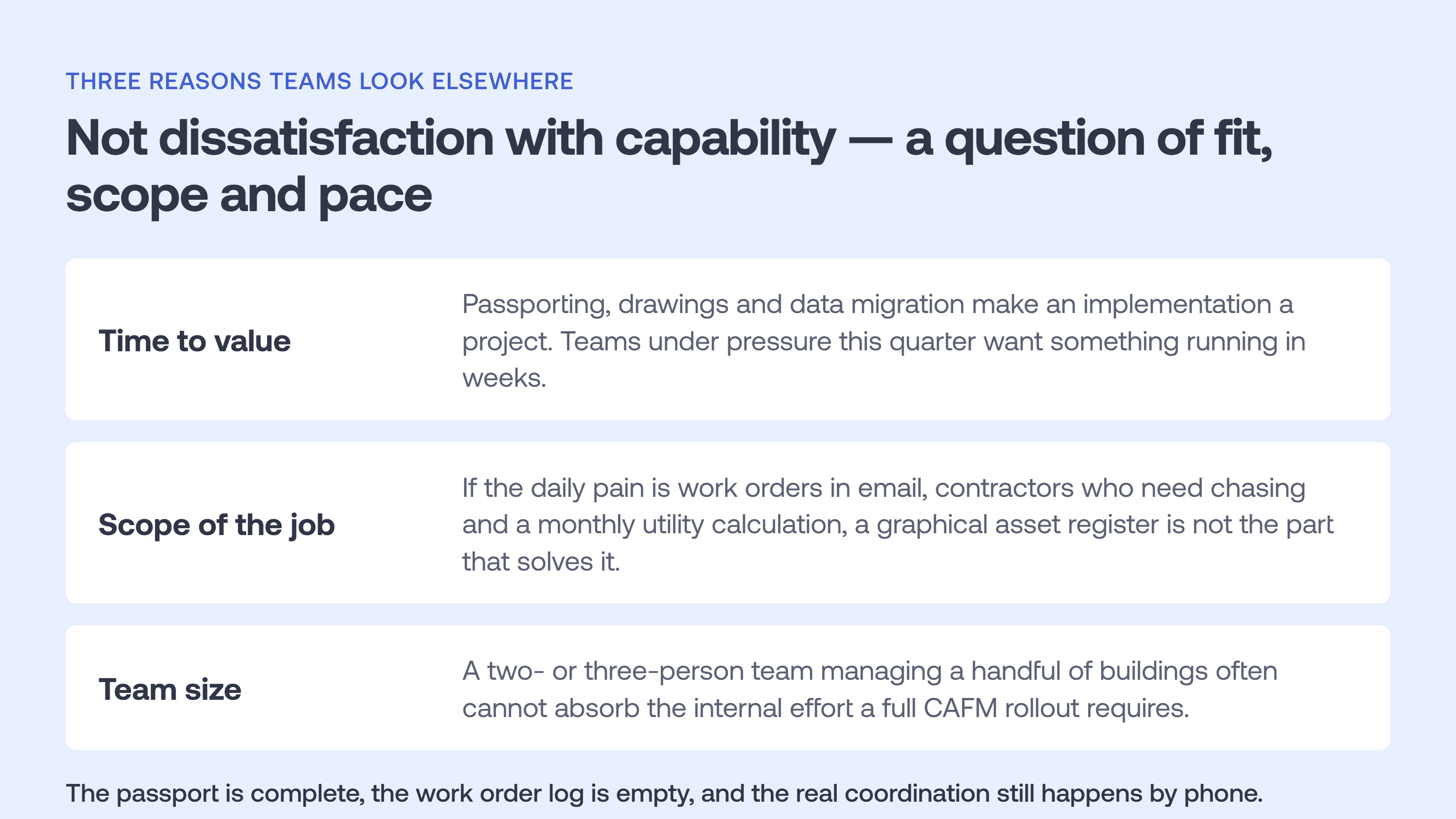
Most teams are not dissatisfied with Chastia's capability. They are reacting to fit, scope or pace.
Three patterns come up repeatedly:
Time to value. A modular CAFM implementation involving passporting, drawings and data migration is a project. Teams under pressure this quarter often want something running in weeks, not after a full data-capture exercise.
Scope of the job to be done. If your actual daily pain is work orders piling up in email, contractors who need chasing, and a monthly utility calculation that eats a week, a graphical asset register is not the part of the system that solves it.
Team size. A two- or three-person property team managing a handful of buildings often cannot absorb the internal effort a full CAFM rollout requires, however good the software is.
The consequence of choosing on capability alone is predictable. Systems that are technically excellent but heavy to populate end up half-used. The passport is complete, the work order log is empty, and the real coordination still happens by phone.
What should you compare when choosing a Chastia alternative?
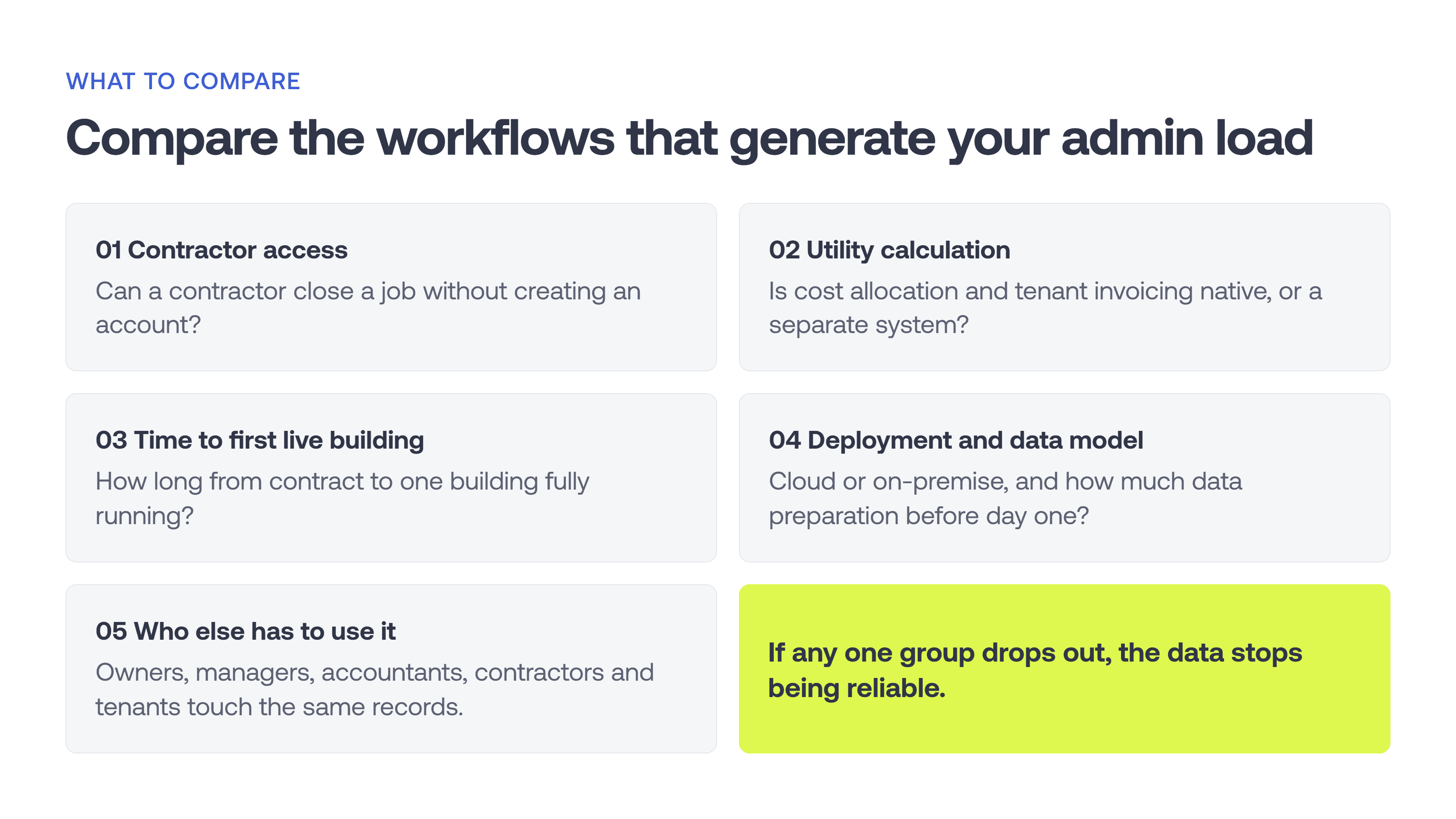
Compare the workflows that generate your admin load, not the module list. Five criteria separate these systems in practice.
Contractor access. Can an external contractor receive, accept and close a job without creating an account or learning a new system? This is the single most common point of failure in facility software rollouts, because adoption depends on people outside your organisation.
Utility calculation and invoicing. Is cost allocation and tenant invoicing native to the platform, or a separate module or a separate system entirely?
Time to first live building. How long from contract to one building fully running, with real work orders in the system?
Deployment and data model. Cloud or on-premise, and how much data preparation is needed before day one? Chastia's approach assumes rich technical documentation. Not every owner has it.
Who else has to use it. Owners, in-house managers, accountants, contractors and tenants all touch the same records. If any one of those groups drops out, the data stops being reliable.
Which are the main Chastia alternatives in Slovakia and Central Europe?
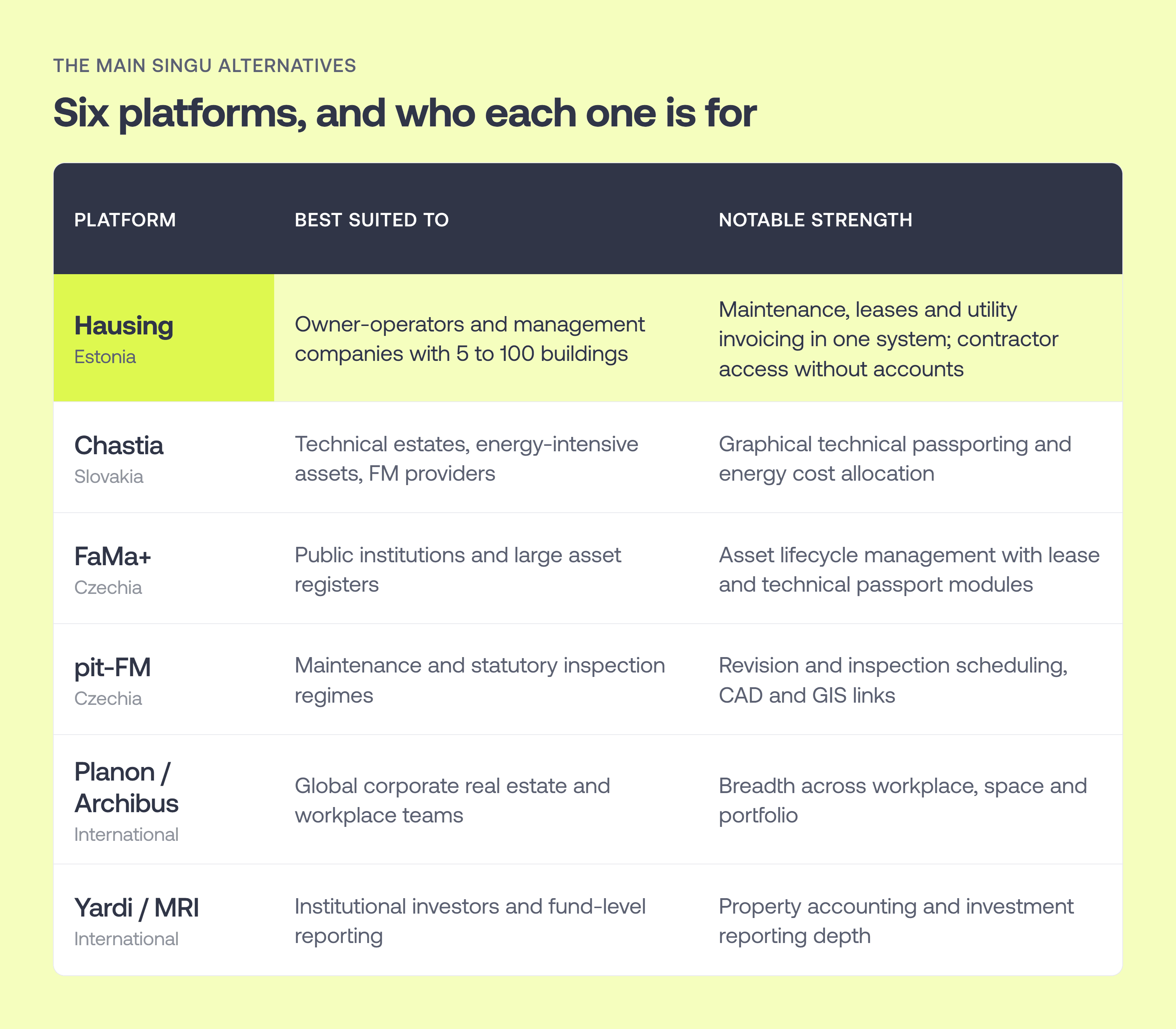
Platform | Origin | Best suited to | Notable strength |
Hausing | Estonia | Owner-operators and management companies wanting one system for maintenance, leases and utility billing | Contractor access without accounts; utility calculation and invoicing built in |
SINGU FM | Poland | Large, multi-country commercial and industrial portfolios | Enterprise CAFM with IoT and ESG reporting |
FaMa+ | Czechia | Public sector and organisations with large asset registers | Asset lifecycle management and technical passporting |
pit-FM | Czechia | Teams whose main driver is statutory inspections and maintenance regimes | Inspection and revision scheduling, CAD and GIS links |
Alstanet | Czechia | Owners with BIM models they want carried into operations | BIM and CDE integration into the operational record |
Planon / Archibus | International | Global corporate real estate and workplace teams | Breadth across workplace, space and portfolio |
Hausing
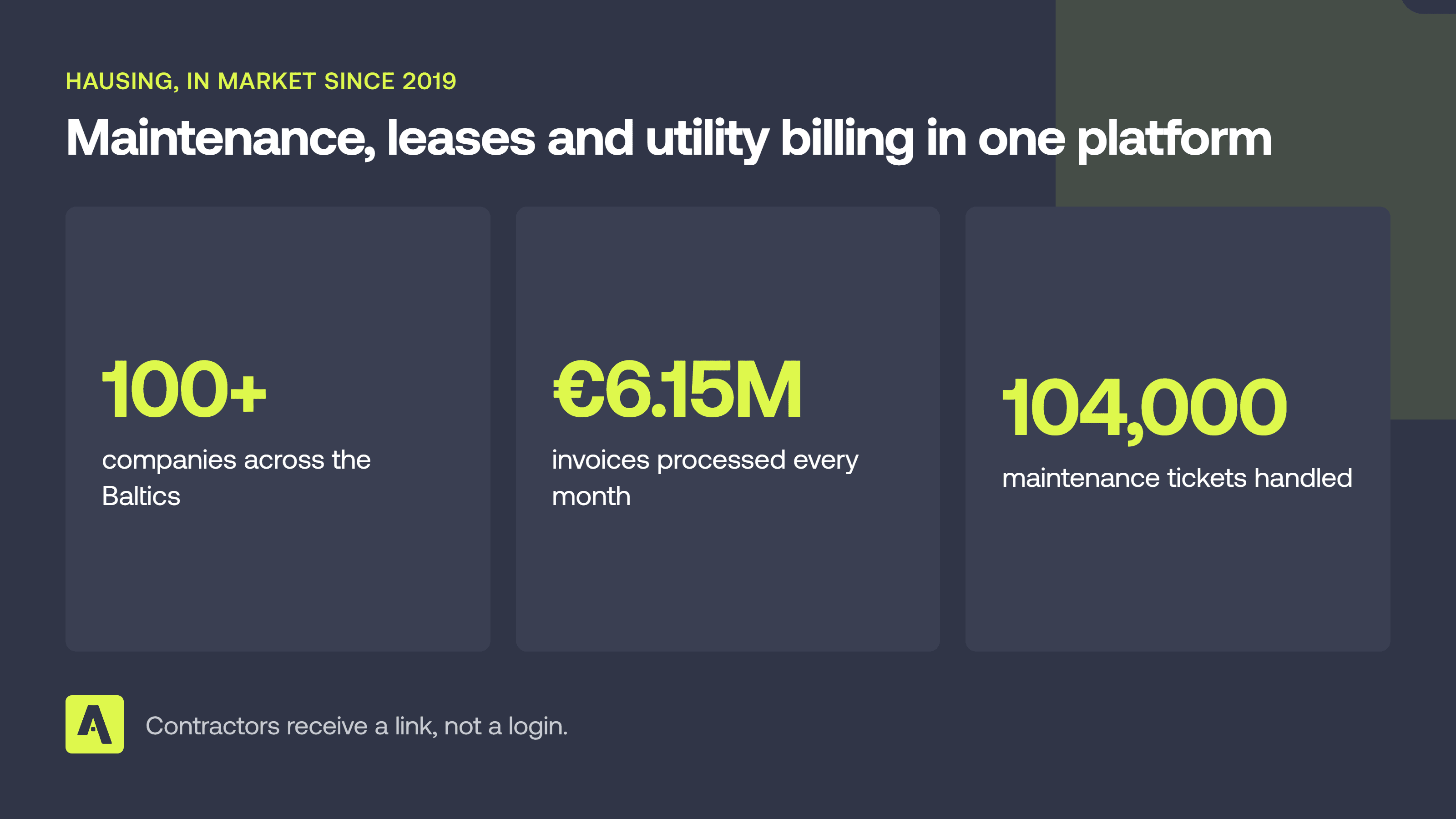
Best for: commercial property owners, operators and management companies who want maintenance, leases and utility invoicing in one shared platform.
Hausing is a cloud commercial property management platform from Estonia, in market since 2019. It covers work orders and maintenance, preventive maintenance scheduling, inspections, lease and service contract management, utility cost calculation and invoicing, CRM, portfolio analytics, a tenant portal and accounting integrations. It works with over 100 companies across the Baltics and processes roughly €6.15 million in invoices monthly, with over 104,000 maintenance tickets created to date.
The biggest difference from Chastia is the contractor layer. Contractors do not need an account. They receive a link, see the job, add comments and photos, and mark it complete, and the update is visible to the owner and tenant at the same moment.
At MyFitness, the largest gym chain in the Baltics, an administration specialist supporting 19 clubs described what that changed for external partners: "For partners without a user account, everything is made very simple. There's no need to log in anywhere, they can just use it straight away." Read the MyFitness case study.
The second difference is billing. Utility cost allocation and tenant invoicing are native, not a separate module. Industrial holding BLRT, which manages more than 15,000 square metres including the Noblessner district in Tallinn, moved off Excel because monthly invoicing and utility calculation was taking a full week every month. Read the BLRT case study.
Honest limitation: Hausing does not offer CAD or GIS drawing-based passporting of the kind Chastia is built around, and its energy management depth is narrower than Chastia's. If your primary requirement is a graphical technical passport tied to drawings, Chastia is the better-suited product.
SINGU FM
Best for: large, multi-country portfolios where standardisation across sites is the main problem.
SINGU, developed by Velis Real Estate Tech in Kraków, is a cloud CAFM and CMMS platform covering facility, maintenance and ESG operations, with IoT integration and a separate tenant engagement app. The vendor states coverage of over 400 customers across 34 countries.
It is the closest regional equivalent to Chastia in ambition, but cloud-first and weighted toward institutional owners and large FM providers. Expect enterprise commercial terms and a corresponding implementation effort.
FaMa+
Best for: public institutions and organisations managing very large asset registers.
FaMa+ from Tesco SW in Czechia combines CAFM with asset lifecycle management, joining the economic, technical and legal views of an asset. It includes a technical passport module for equipment with statutory activity planning, a lease relations module covering the rental process, and a field mobile app for technicians called Rudy. Its public-sector version is built specifically for public institutions.
pit-FM
Best for: teams whose main driver is statutory inspections, revisions and planned maintenance.
pit-FM from pit Software is a Czech CAFM system aimed at maintenance and legislative activities such as revisions and inspections. It includes passporting of sites, buildings, areas and building technical equipment, order and task management, CRM and contract management, plus a reminder system and two-way links to CAD and GIS tools.
Alstanet
Best for: owners with BIM models who want design-phase data to survive into operations.
Alstanet is a Czech CAFM vendor active in BIM projects and a member of the CZ BIM association. Its approach connects BIM and CDE platforms directly to the operational record, so information defined in the model is available in the CAFM system without re-entry. It is delivered partly through implementation partners.
Planon and Archibus
Best for: international corporate real estate and workplace teams.
The global enterprise CAFM and IWMS suites cover workplace, space, portfolio and maintenance at a breadth no regional vendor matches. They are also the heaviest to implement and the most expensive to run. For a Slovak owner with a single-country portfolio, they are usually oversized.
When is Chastia still the right choice?
Chastia remains the stronger option in three situations, and it is worth saying so plainly.
If your technical documentation is your most valuable asset and you need drawings, areas and equipment linked in a searchable graphical database, Chastia's data model is purpose-built for it and most cloud platforms are not.
If energy consumption records, budgeting and cost allocation are the core of your business, for example as a heat supplier or an energy services provider, Chastia's energy modules are unusually deep for a regional vendor.
If you value a Slovak vendor with local implementation staff and a long track record, Chastia has offices in Poprad, Košice and Bratislava and has been embedded in the Slovak facility management community for years, including running the FM Camp and EnergyCamp conferences.
How do you run a fair comparison in 30 days without a procurement project?
Pick one building and one workflow, and test the same thing in every system on your shortlist. This produces a better decision than a feature matrix, and it takes weeks rather than months.
A workable 30-day sequence:
Week 1. Choose your worst building and your most common recurring job type. Write down what happens today, step by step, including every email and phone call.
Week 2. Run a trial or demo of each shortlisted system using that exact job. Insist on seeing the contractor's view, not just the manager's dashboard.
Week 3. Run one real month-end task in the two strongest candidates, ideally a utility calculation or an inspection. This is where systems separate.
Week 4. Ask one contractor and one tenant which experience they preferred. Their answer predicts your adoption rate more accurately than anything else.
The pattern to watch for is whether the system reduces the number of people a single task has to pass through. Taavi Konga, Head of Construction at residential developer Liven, described the underlying problem this way: work becomes slow when there are too many links in the chain, meaning one task needs too many people, too much time and unnecessary process steps. Read the Liven case study.
Frequently asked questions
What is the best alternative to Chastia?
There is no single best alternative, because Chastia serves several different jobs. For owner-operators who need maintenance, leases and utility invoicing in one cloud system, Hausing is the closest fit. For large multi-country portfolios, SINGU FM is the nearest regional equivalent. For public-sector asset registers, FaMa+ is built for that use case.
Is there a cloud alternative to Chastia FM?
Yes. SINGU FM and Hausing are both cloud platforms requiring no local server infrastructure. Cloud deployment generally shortens the time to a first live building, because there is no installation phase and updates arrive automatically.
Do I need a full CAFM system to manage a commercial building?
Not always. If your daily load is work orders, contractor coordination, preventive maintenance schedules and monthly tenant invoicing, a property management platform covering those workflows is usually sufficient. A full CAFM system with graphical passporting is justified when detailed technical documentation is central to how you operate the asset.
How long does it take to move off spreadsheets?
It depends on data quality more than software. Saku Brewery, part of the Carlsberg Group, moved its maintenance management from Excel and now logs roughly 50 to 100 tasks per month, with its maintenance manager estimating a saving of about an hour every working day. Read the Saku Brewery case study.
What happens to our data if the person who manages it leaves?
That risk is exactly why many teams change systems. At BLRT, the trigger for replacing Excel was a colleague leaving after years of running leases and shared utility costs alone, with systems nobody else could interpret. A shared platform keeps the history in the system rather than in one person's head.
Ready to see the difference in your own building?
If your monthly utility calculation still takes a week, and half your work orders live in an inbox, the fastest way to find out whether a lighter platform fits is to run one building through it.
Try Hausing free and set up your first building this week.
Sources used
chastia.com product and solutions pages
profesia.sk company profile for CHASTIA s.r.o. (offices, product line)
fmjournal.cz CAFM ebook (vendor overviews, company background)
singu.com and Velis Real Estate Tech public materials
famaplus.cz and tescosw.cz
pitsoftware.cz
controlis.cz (Alstanet partnership)
Hausing.co case studies, linked inline
In this article / TLDR
Chastia is a Slovak CAFM system built around graphical asset registers, technical passporting and energy cost allocation. It is strong, established and deeply rooted in the Slovak market.
Teams usually look for an alternative for one of three reasons: they want faster deployment, they want leases and utility invoicing handled in the same system as maintenance, or they are too small to justify a full modular CAFM project.
The realistic alternatives in this region are Hausing, SINGU FM, FaMa+, pit-FM, Alstanet and the international enterprise suites such as Planon and Archibus.
The right choice depends far more on who uses the system daily, including your contractors and tenants, than on the length of the feature list.
If your bottleneck is work orders, contractor coordination and monthly utility billing rather than CAD drawings, a lighter cloud platform will usually go live faster and get adopted more reliably.
Related insights

Are you ready?
Centralize your property management workflows.
Chastia alternatives: six property and facility management systems compared
News
•
Table of Contents
Be the first to know about our latest projects and news
What is Chastia, and who is it built for?
Chastia is a Slovak software company that develops Chastia FM, a modular CAFM system for recording, operating, maintaining and costing building assets. The company was founded by the Stanek family and operates from Poprad, with further offices in Košice, Bratislava and Prague.
The product line covers three parts: Chastia FM for the core asset and maintenance system, Chastia ONE for helpdesk and unplanned maintenance requests, and Chastia IoT for automated data collection. The system is consistently modular, which means modules are supplied according to what each customer orders.
Its defining characteristic is graphical depth. Drawings and graphic entities are stored in the database itself, so you can search for every drawing that contains a given room, area or piece of equipment. That makes Chastia a natural fit for organisations that own detailed technical documentation and need to keep it alive over decades.
Chastia's second strength is energy. Consumption records, energy and service budgeting, cost allocation and invoicing for those services sit at the centre of the product, which is why it appears frequently with heat suppliers, municipalities, industrial operators and outsourced facility management providers.
Why do Slovak property teams look for a Chastia alternative?
Most teams are not dissatisfied with Chastia's capability. They are reacting to fit, scope or pace.
Three patterns come up repeatedly:
Time to value. A modular CAFM implementation involving passporting, drawings and data migration is a project. Teams under pressure this quarter often want something running in weeks, not after a full data-capture exercise.
Scope of the job to be done. If your actual daily pain is work orders piling up in email, contractors who need chasing, and a monthly utility calculation that eats a week, a graphical asset register is not the part of the system that solves it.
Team size. A two- or three-person property team managing a handful of buildings often cannot absorb the internal effort a full CAFM rollout requires, however good the software is.
The consequence of choosing on capability alone is predictable. Systems that are technically excellent but heavy to populate end up half-used. The passport is complete, the work order log is empty, and the real coordination still happens by phone.
What should you compare when choosing a Chastia alternative?
Compare the workflows that generate your admin load, not the module list. Five criteria separate these systems in practice.
Contractor access. Can an external contractor receive, accept and close a job without creating an account or learning a new system? This is the single most common point of failure in facility software rollouts, because adoption depends on people outside your organisation.
Utility calculation and invoicing. Is cost allocation and tenant invoicing native to the platform, or a separate module or a separate system entirely?
Time to first live building. How long from contract to one building fully running, with real work orders in the system?
Deployment and data model. Cloud or on-premise, and how much data preparation is needed before day one? Chastia's approach assumes rich technical documentation. Not every owner has it.
Who else has to use it. Owners, in-house managers, accountants, contractors and tenants all touch the same records. If any one of those groups drops out, the data stops being reliable.
Which are the main Chastia alternatives in Slovakia and Central Europe?
Platform | Origin | Best suited to | Notable strength |
Hausing | Estonia | Owner-operators and management companies wanting one system for maintenance, leases and utility billing | Contractor access without accounts; utility calculation and invoicing built in |
SINGU FM | Poland | Large, multi-country commercial and industrial portfolios | Enterprise CAFM with IoT and ESG reporting |
FaMa+ | Czechia | Public sector and organisations with large asset registers | Asset lifecycle management and technical passporting |
pit-FM | Czechia | Teams whose main driver is statutory inspections and maintenance regimes | Inspection and revision scheduling, CAD and GIS links |
Alstanet | Czechia | Owners with BIM models they want carried into operations | BIM and CDE integration into the operational record |
Planon / Archibus | International | Global corporate real estate and workplace teams | Breadth across workplace, space and portfolio |
Hausing
Best for: commercial property owners, operators and management companies who want maintenance, leases and utility invoicing in one shared platform.
Hausing is a cloud commercial property management platform from Estonia, in market since 2019. It covers work orders and maintenance, preventive maintenance scheduling, inspections, lease and service contract management, utility cost calculation and invoicing, CRM, portfolio analytics, a tenant portal and accounting integrations. It works with over 100 companies across the Baltics and processes roughly €6.15 million in invoices monthly, with over 104,000 maintenance tickets created to date.
The biggest difference from Chastia is the contractor layer. Contractors do not need an account. They receive a link, see the job, add comments and photos, and mark it complete, and the update is visible to the owner and tenant at the same moment.
At MyFitness, the largest gym chain in the Baltics, an administration specialist supporting 19 clubs described what that changed for external partners: "For partners without a user account, everything is made very simple. There's no need to log in anywhere, they can just use it straight away." Read the MyFitness case study.
The second difference is billing. Utility cost allocation and tenant invoicing are native, not a separate module. Industrial holding BLRT, which manages more than 15,000 square metres including the Noblessner district in Tallinn, moved off Excel because monthly invoicing and utility calculation was taking a full week every month. Read the BLRT case study.
Honest limitation: Hausing does not offer CAD or GIS drawing-based passporting of the kind Chastia is built around, and its energy management depth is narrower than Chastia's. If your primary requirement is a graphical technical passport tied to drawings, Chastia is the better-suited product.
SINGU FM
Best for: large, multi-country portfolios where standardisation across sites is the main problem.
SINGU, developed by Velis Real Estate Tech in Kraków, is a cloud CAFM and CMMS platform covering facility, maintenance and ESG operations, with IoT integration and a separate tenant engagement app. The vendor states coverage of over 400 customers across 34 countries.
It is the closest regional equivalent to Chastia in ambition, but cloud-first and weighted toward institutional owners and large FM providers. Expect enterprise commercial terms and a corresponding implementation effort.
FaMa+
Best for: public institutions and organisations managing very large asset registers.
FaMa+ from Tesco SW in Czechia combines CAFM with asset lifecycle management, joining the economic, technical and legal views of an asset. It includes a technical passport module for equipment with statutory activity planning, a lease relations module covering the rental process, and a field mobile app for technicians called Rudy. Its public-sector version is built specifically for public institutions.
pit-FM
Best for: teams whose main driver is statutory inspections, revisions and planned maintenance.
pit-FM from pit Software is a Czech CAFM system aimed at maintenance and legislative activities such as revisions and inspections. It includes passporting of sites, buildings, areas and building technical equipment, order and task management, CRM and contract management, plus a reminder system and two-way links to CAD and GIS tools.
Alstanet
Best for: owners with BIM models who want design-phase data to survive into operations.
Alstanet is a Czech CAFM vendor active in BIM projects and a member of the CZ BIM association. Its approach connects BIM and CDE platforms directly to the operational record, so information defined in the model is available in the CAFM system without re-entry. It is delivered partly through implementation partners.
Planon and Archibus
Best for: international corporate real estate and workplace teams.
The global enterprise CAFM and IWMS suites cover workplace, space, portfolio and maintenance at a breadth no regional vendor matches. They are also the heaviest to implement and the most expensive to run. For a Slovak owner with a single-country portfolio, they are usually oversized.
When is Chastia still the right choice?
Chastia remains the stronger option in three situations, and it is worth saying so plainly.
If your technical documentation is your most valuable asset and you need drawings, areas and equipment linked in a searchable graphical database, Chastia's data model is purpose-built for it and most cloud platforms are not.
If energy consumption records, budgeting and cost allocation are the core of your business, for example as a heat supplier or an energy services provider, Chastia's energy modules are unusually deep for a regional vendor.
If you value a Slovak vendor with local implementation staff and a long track record, Chastia has offices in Poprad, Košice and Bratislava and has been embedded in the Slovak facility management community for years, including running the FM Camp and EnergyCamp conferences.
How do you run a fair comparison in 30 days without a procurement project?
Pick one building and one workflow, and test the same thing in every system on your shortlist. This produces a better decision than a feature matrix, and it takes weeks rather than months.
A workable 30-day sequence:
Week 1. Choose your worst building and your most common recurring job type. Write down what happens today, step by step, including every email and phone call.
Week 2. Run a trial or demo of each shortlisted system using that exact job. Insist on seeing the contractor's view, not just the manager's dashboard.
Week 3. Run one real month-end task in the two strongest candidates, ideally a utility calculation or an inspection. This is where systems separate.
Week 4. Ask one contractor and one tenant which experience they preferred. Their answer predicts your adoption rate more accurately than anything else.
The pattern to watch for is whether the system reduces the number of people a single task has to pass through. Taavi Konga, Head of Construction at residential developer Liven, described the underlying problem this way: work becomes slow when there are too many links in the chain, meaning one task needs too many people, too much time and unnecessary process steps. Read the Liven case study.
Frequently asked questions
What is the best alternative to Chastia?
There is no single best alternative, because Chastia serves several different jobs. For owner-operators who need maintenance, leases and utility invoicing in one cloud system, Hausing is the closest fit. For large multi-country portfolios, SINGU FM is the nearest regional equivalent. For public-sector asset registers, FaMa+ is built for that use case.
Is there a cloud alternative to Chastia FM?
Yes. SINGU FM and Hausing are both cloud platforms requiring no local server infrastructure. Cloud deployment generally shortens the time to a first live building, because there is no installation phase and updates arrive automatically.
Do I need a full CAFM system to manage a commercial building?
Not always. If your daily load is work orders, contractor coordination, preventive maintenance schedules and monthly tenant invoicing, a property management platform covering those workflows is usually sufficient. A full CAFM system with graphical passporting is justified when detailed technical documentation is central to how you operate the asset.
How long does it take to move off spreadsheets?
It depends on data quality more than software. Saku Brewery, part of the Carlsberg Group, moved its maintenance management from Excel and now logs roughly 50 to 100 tasks per month, with its maintenance manager estimating a saving of about an hour every working day. Read the Saku Brewery case study.
What happens to our data if the person who manages it leaves?
That risk is exactly why many teams change systems. At BLRT, the trigger for replacing Excel was a colleague leaving after years of running leases and shared utility costs alone, with systems nobody else could interpret. A shared platform keeps the history in the system rather than in one person's head.
Ready to see the difference in your own building?
If your monthly utility calculation still takes a week, and half your work orders live in an inbox, the fastest way to find out whether a lighter platform fits is to run one building through it.
Try Hausing free and set up your first building this week.
Sources used
chastia.com product and solutions pages
profesia.sk company profile for CHASTIA s.r.o. (offices, product line)
fmjournal.cz CAFM ebook (vendor overviews, company background)
singu.com and Velis Real Estate Tech public materials
famaplus.cz and tescosw.cz
pitsoftware.cz
controlis.cz (Alstanet partnership)
Hausing.co case studies, linked inline
In this article / TLDR
Chastia is a Slovak CAFM system built around graphical asset registers, technical passporting and energy cost allocation. It is strong, established and deeply rooted in the Slovak market.
Teams usually look for an alternative for one of three reasons: they want faster deployment, they want leases and utility invoicing handled in the same system as maintenance, or they are too small to justify a full modular CAFM project.
The realistic alternatives in this region are Hausing, SINGU FM, FaMa+, pit-FM, Alstanet and the international enterprise suites such as Planon and Archibus.
The right choice depends far more on who uses the system daily, including your contractors and tenants, than on the length of the feature list.
If your bottleneck is work orders, contractor coordination and monthly utility billing rather than CAD drawings, a lighter cloud platform will usually go live faster and get adopted more reliably.
Related insights
Centralize your property management workflows.