Preventive vs reactive maintenance: what does running reactive-only really cost an office building?
News
•

Table of Contents
Be the first to know about our latest projects and news
A short TL;DR first -
Now let's dive deeper into the details.
Every building runs on one of two maintenance models. In the reactive model, things break, and you fix them. In the preventive model, you service devices on a schedule so fewer things break.
Most portfolios say they want the second model and quietly run the first. Here is why that is more expensive than it looks, and how to make the switch without hiring anyone.
What is the difference between preventive and reactive maintenance?
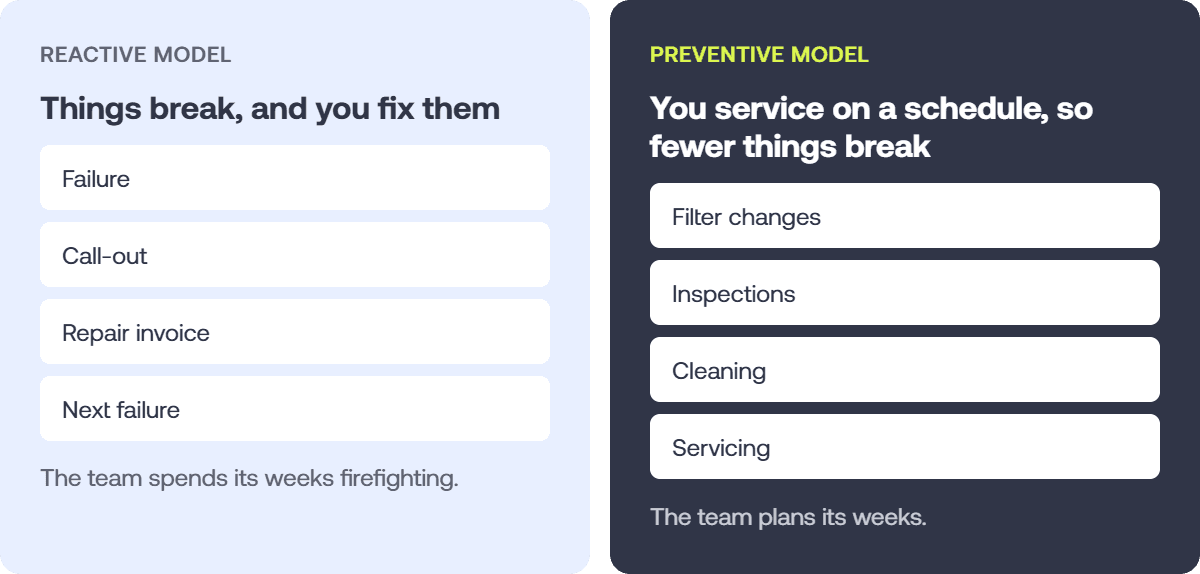
Reactive maintenance responds to failures after they happen. Preventive maintenance involves regular check-ups and scheduled tasks - filter changes, inspections, cleaning, servicing - that prevent potential issues before they become major problems.
The distinction sounds administrative. In practice, it shapes your year: whether your team plans its weeks or spends them firefighting.
Why is reactive-only maintenance so expensive?
The repair invoice is only part of the cost. The full cost of running reactive-only includes:
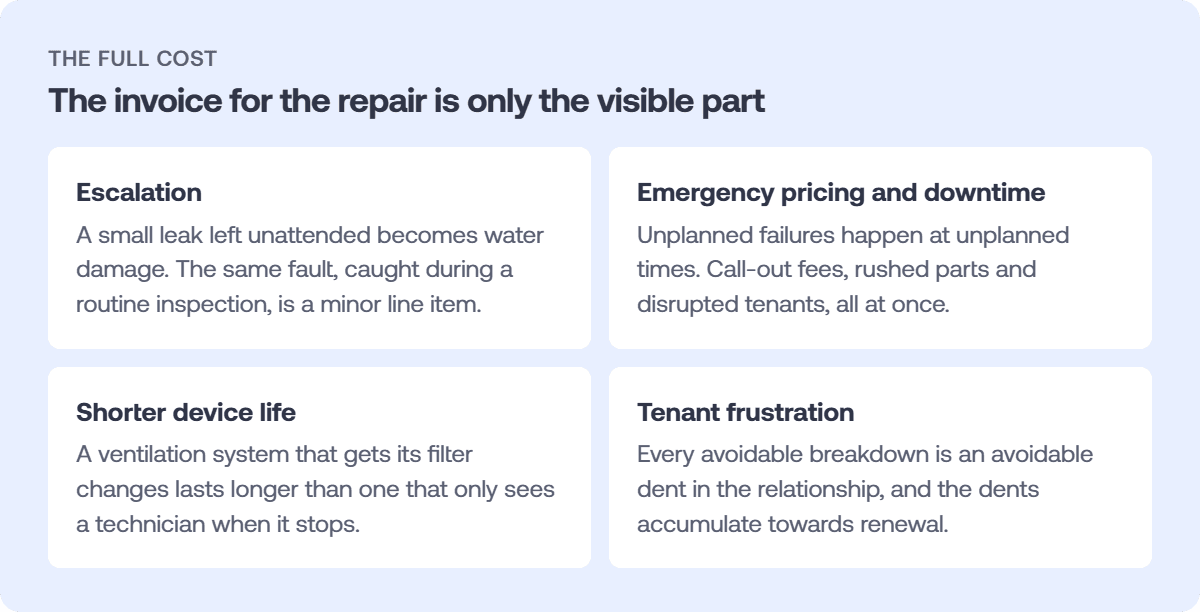
Escalation. Small faults grow while nobody is looking. A small leak left unattended can become costly water damage or an expensive emergency replacement. The same fault, caught during a routine inspection, is a minor line item.
Emergency pricing and downtime. Unplanned failures happen at unplanned times, which means call-out fees, rushed parts and disrupted tenants - all at once.
Shorter device life. Devices that are never serviced fail earlier. A ventilation system that gets its filter changes and check-ups simply lasts longer than one that only sees a technician when it stops.
Tenant frustration. Tenant complaints are very often maintenance complaints. Every avoidable breakdown is an avoidable dent in the relationship - and in an office building, those dents accumulate towards renewal time.
See how Hausing supports business campus property management end to end.
Why do buildings stay stuck in reactive mode?
Rarely because anyone chose it. Usually because preventive maintenance requires a system, and the system never got built.
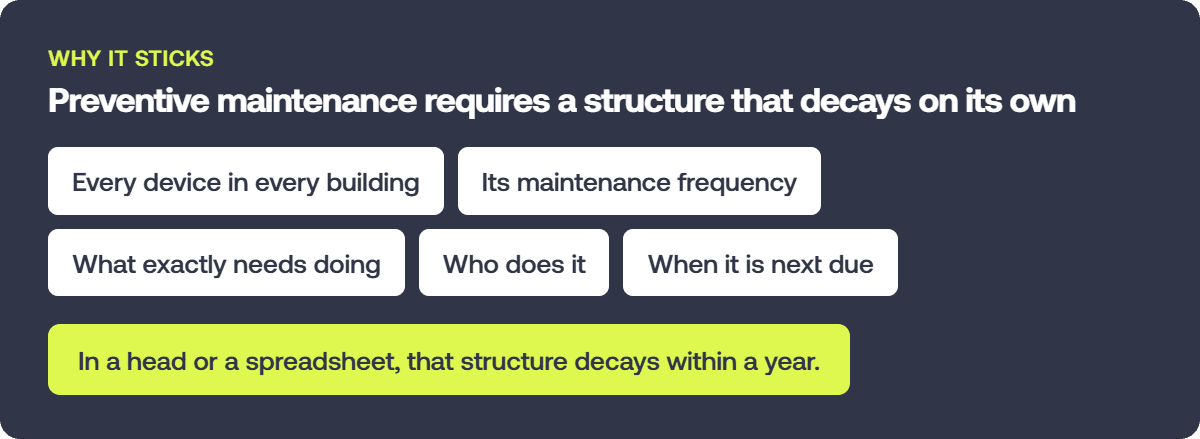
To run preventive maintenance, you need to know: every device in every building, its maintenance frequency, what exactly needs doing, who does it, and when it is next due. If it lives in someone's head or a forgotten spreadsheet, that structure decays within a year.
How do you set up a preventive maintenance schedule?
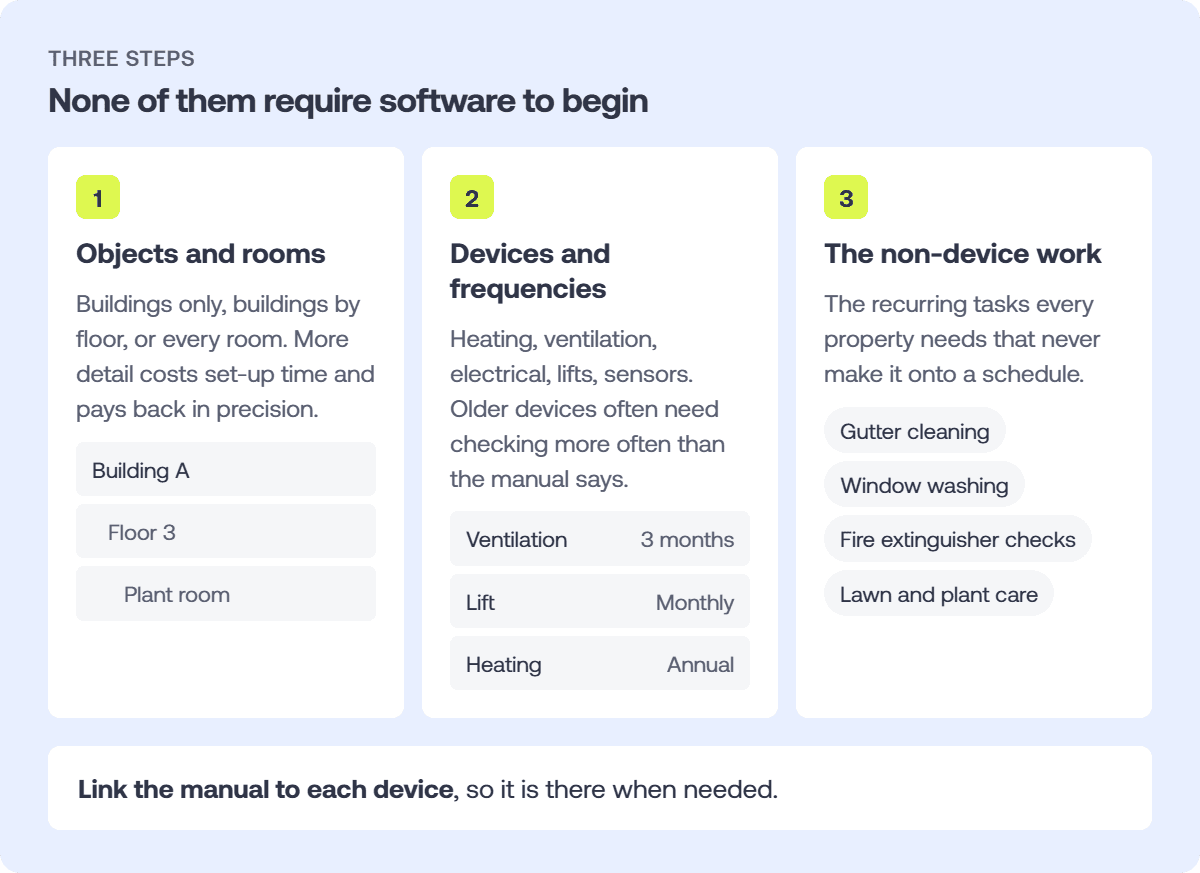
Three steps, and none of them require software to begin - although software keeps the result alive.
Step 1: List your objects and rooms. Decide the level of detail: buildings only, buildings broken into floors, or every room. More detail costs more set-up time but pays back in precision - the person doing the maintenance knows exactly where everything is.
Step 2: List your devices and frequencies. Heating, ventilation, electrical systems, lifts, sensors. Take frequencies from the manuals and from your own experience - older devices often need more frequent checks than the manual suggests. Link the manual to each device so it is there when needed.
Step 3: Add the non-device work. Gutter cleaning, window washing, fire extinguisher checks, lawn and plant care - the recurring tasks every property needs that never make it onto a schedule.
Here's a full step-by-step guide to setting up a preventive maintenance schedule if you want the detailed version.
How does this work day-to-day in practice?
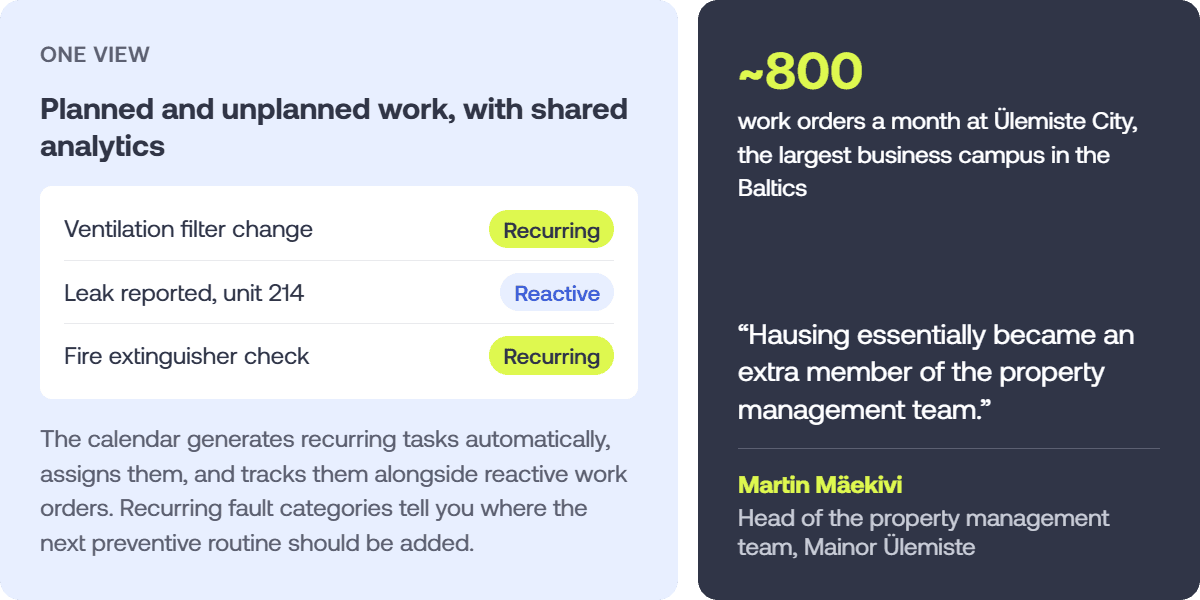
In Hausing, the preventive maintenance calendar automatically generates recurring tasks, assigns them, and tracks them alongside your reactive work orders. So, planned and unplanned work live in one view, with shared analytics.
You see incoming task counts, categories, and statuses, and recurring fault categories tell you exactly where to add the next preventive routine.
Ülemiste City, the largest business campus in the Baltics, runs roughly 800 work orders a month this way. Their maintenance manager's verdict: "Hausing essentially became an extra member of the property management team,” said Martin Mäekivi, the head of the property management team at Mainor Ülemiste. Read the Ülemiste City case study.
Where should you start today?
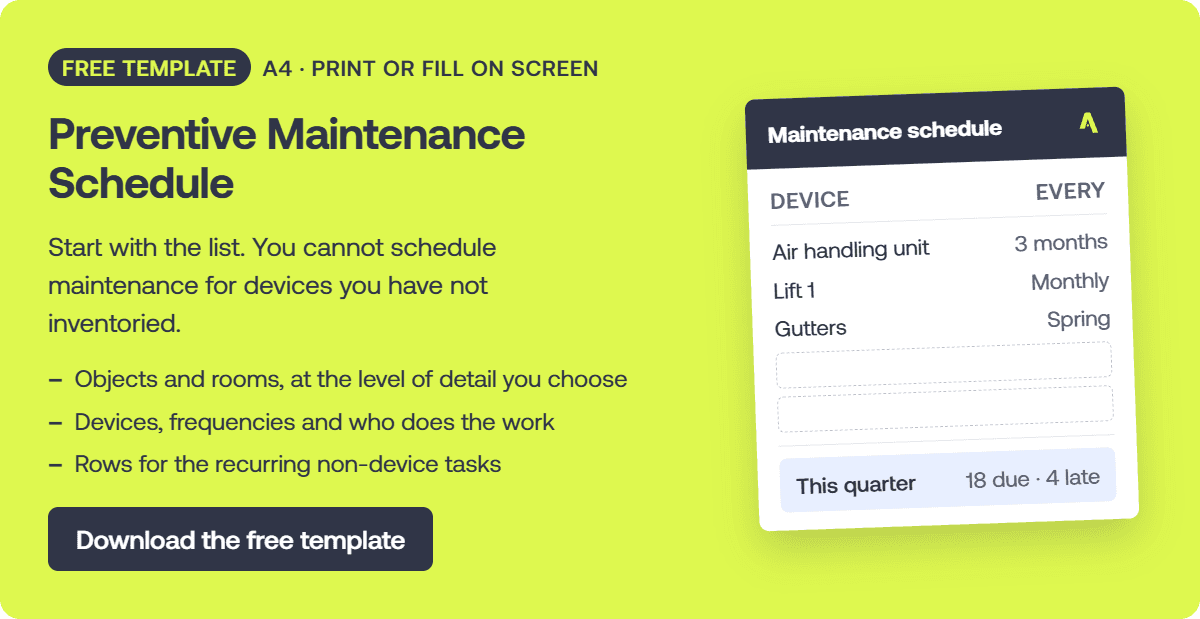
Start with the list. You cannot schedule maintenance for devices you have not inventoried.
Download the free Preventive Maintenance Schedule template and complete Step 1 today by owning the full overview of your buildings.
Want to skip the spreadsheet stage entirely? Try Hausing for free or book a demo and see the preventive maintenance calendar generate your schedule automatically.
In this article / TLDR
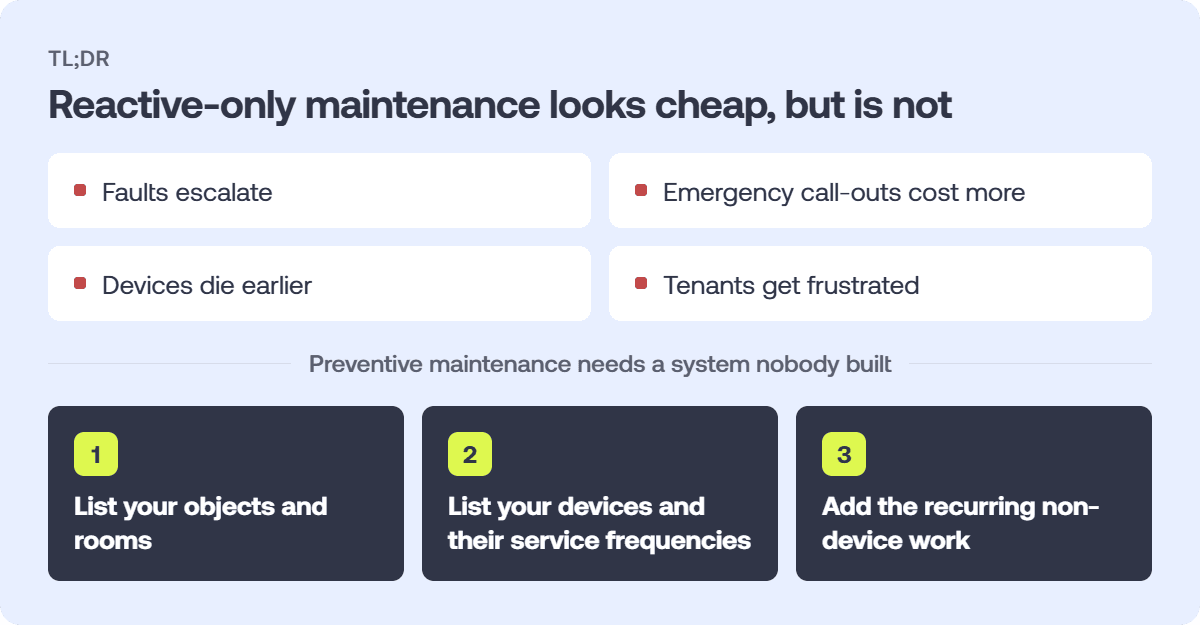
Reactive-only maintenance looks cheap but isn't: faults escalate, emergency call-outs cost more, devices die earlier, and tenants get frustrated. Buildings stay stuck in reactive mode because preventive maintenance needs a system nobody built. The fix is three steps: list your objects and rooms, list your devices and their service frequencies, and add the recurring non-device work - then let software keep the schedule alive.
Your download is ready
Thanks — here’s the full document. It’s yours to keep and share internally.
Related insights


Are you ready?
Centralize your property management workflows.
Preventive vs reactive maintenance: what does running reactive-only really cost an office building?
News
•
Table of Contents
Be the first to know about our latest projects and news
A short TL;DR first -
Now let's dive deeper into the details.
Every building runs on one of two maintenance models. In the reactive model, things break, and you fix them. In the preventive model, you service devices on a schedule so fewer things break.
Most portfolios say they want the second model and quietly run the first. Here is why that is more expensive than it looks, and how to make the switch without hiring anyone.
What is the difference between preventive and reactive maintenance?
Reactive maintenance responds to failures after they happen. Preventive maintenance involves regular check-ups and scheduled tasks - filter changes, inspections, cleaning, servicing - that prevent potential issues before they become major problems.
The distinction sounds administrative. In practice, it shapes your year: whether your team plans its weeks or spends them firefighting.
Why is reactive-only maintenance so expensive?
The repair invoice is only part of the cost. The full cost of running reactive-only includes:
Escalation. Small faults grow while nobody is looking. A small leak left unattended can become costly water damage or an expensive emergency replacement. The same fault, caught during a routine inspection, is a minor line item.
Emergency pricing and downtime. Unplanned failures happen at unplanned times, which means call-out fees, rushed parts and disrupted tenants - all at once.
Shorter device life. Devices that are never serviced fail earlier. A ventilation system that gets its filter changes and check-ups simply lasts longer than one that only sees a technician when it stops.
Tenant frustration. Tenant complaints are very often maintenance complaints. Every avoidable breakdown is an avoidable dent in the relationship - and in an office building, those dents accumulate towards renewal time.
See how Hausing supports business campus property management end to end.
Why do buildings stay stuck in reactive mode?
Rarely because anyone chose it. Usually because preventive maintenance requires a system, and the system never got built.
To run preventive maintenance, you need to know: every device in every building, its maintenance frequency, what exactly needs doing, who does it, and when it is next due. If it lives in someone's head or a forgotten spreadsheet, that structure decays within a year.
How do you set up a preventive maintenance schedule?
Three steps, and none of them require software to begin - although software keeps the result alive.
Step 1: List your objects and rooms. Decide the level of detail: buildings only, buildings broken into floors, or every room. More detail costs more set-up time but pays back in precision - the person doing the maintenance knows exactly where everything is.
Step 2: List your devices and frequencies. Heating, ventilation, electrical systems, lifts, sensors. Take frequencies from the manuals and from your own experience - older devices often need more frequent checks than the manual suggests. Link the manual to each device so it is there when needed.
Step 3: Add the non-device work. Gutter cleaning, window washing, fire extinguisher checks, lawn and plant care - the recurring tasks every property needs that never make it onto a schedule.
Here's a full step-by-step guide to setting up a preventive maintenance schedule if you want the detailed version.
How does this work day-to-day in practice?
In Hausing, the preventive maintenance calendar automatically generates recurring tasks, assigns them, and tracks them alongside your reactive work orders. So, planned and unplanned work live in one view, with shared analytics.
You see incoming task counts, categories, and statuses, and recurring fault categories tell you exactly where to add the next preventive routine.
Ülemiste City, the largest business campus in the Baltics, runs roughly 800 work orders a month this way. Their maintenance manager's verdict: "Hausing essentially became an extra member of the property management team,” said Martin Mäekivi, the head of the property management team at Mainor Ülemiste. Read the Ülemiste City case study.
Where should you start today?
Start with the list. You cannot schedule maintenance for devices you have not inventoried.
Download the free Preventive Maintenance Schedule template and complete Step 1 today by owning the full overview of your buildings.
Want to skip the spreadsheet stage entirely? Try Hausing for free or book a demo and see the preventive maintenance calendar generate your schedule automatically.
In this article / TLDR
Reactive-only maintenance looks cheap but isn't: faults escalate, emergency call-outs cost more, devices die earlier, and tenants get frustrated. Buildings stay stuck in reactive mode because preventive maintenance needs a system nobody built. The fix is three steps: list your objects and rooms, list your devices and their service frequencies, and add the recurring non-device work - then let software keep the schedule alive.
Your download is ready
Thanks — here’s the full document. It’s yours to keep and share internally.
Related insights
Centralize your property management workflows.