The 3 warranty management challenges every developer hits (and how to solve them)
News
•

Table of Contents
Be the first to know about our latest projects and news
A construction company typically provides a two-year warranty after handover. Homeowners can report problems as they appear, or collect them and report them near the end.
Either way, for the developer, those two years are an operational marathon: many buildings, any claims, many contractors, and a customer relationship that is decided by how smoothly it all runs.
The challenges look different from the homeowner's side and the developer's side, but the fix is shared: the developer has to build processes that are understandable and smooth for all parties.
Here are the three challenges that come up in almost every warranty operation, and how to solve each one.
Challenge 1: Information overflow and forgotten deadlines
Many buildings need tracking at the same time. Claims arrive by email, phone and in person. Each project manager keeps their own records.
The result is information overflow - and we all know what that means: things get forgotten or mixed up without a proper system. Forgotten deadlines and broken promises equal unhappy clients.
The solution: one system for everything.
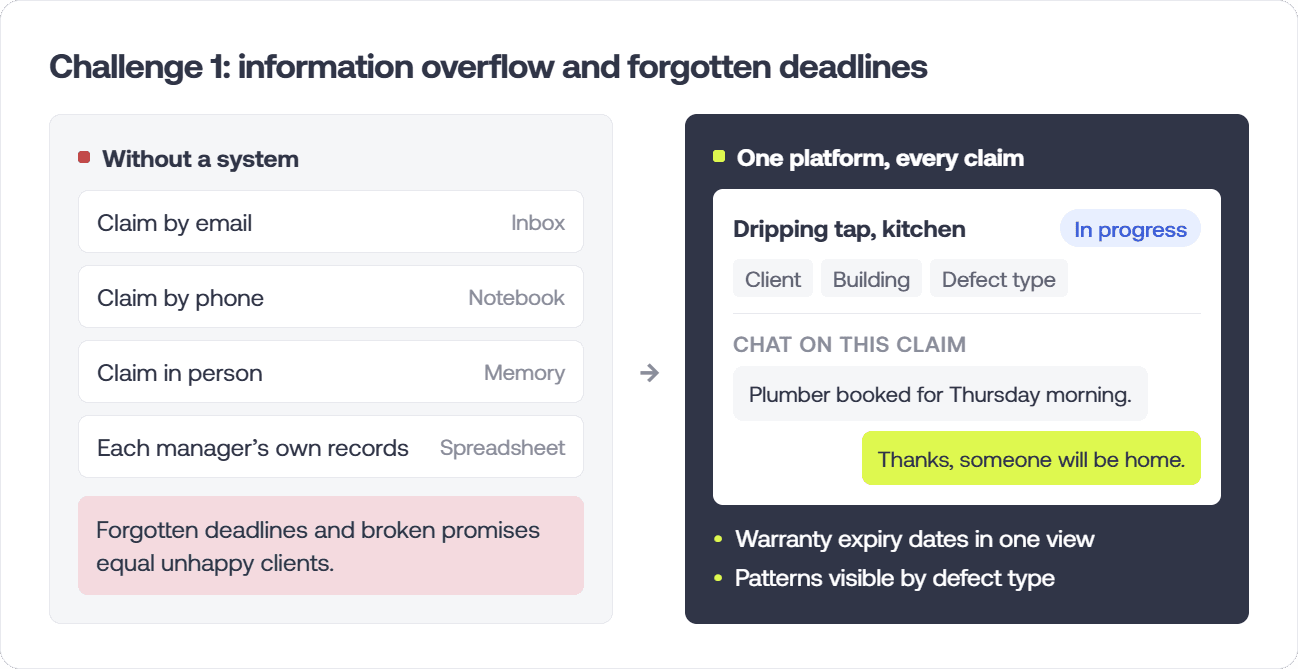
Manage all warranty information on a single platform that connects your employees, contractors, and clients. There you can monitor warranty expiration dates, analyse incoming data and communicate with homeowners and contractors in one place.
Two details make the difference in practice.
First, keep communication attached to the claim - in Hausing, a chat function sits directly under the task that needs solving, so the information stays focused in one place. Even when work runs late, nothing earns a homeowner's patience like good communication.
Second, categorise everything by client, building and defect type. If you notice all the taps in a project are dripping, it may be time to change supplier before the next project - but you only see the pattern if the data is in one place.
Challenge 2: No easy access to important documents
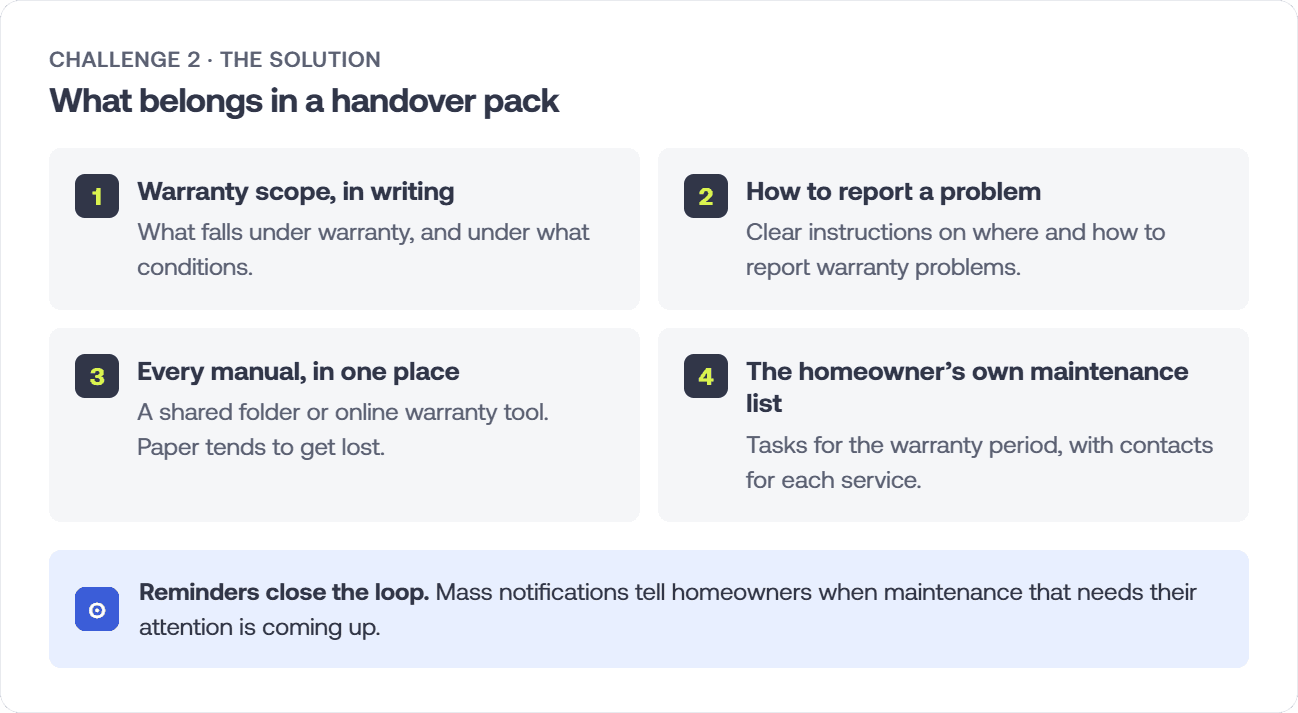
Homeowners - especially first-time buyers - are often confused about the basics: which defects must the builder fix, and which problems are the homeowner's own responsibility? Where are the device manuals? What maintenance must the owner do themselves?
This confusion costs the developer directly: it produces non-warranty claims that consume your team's time, and neglected devices that fail earlier than they should. Well-maintained devices last much longer than neglected ones.
The solution: a proper handover pack, kept somewhere it can't get lost.
Challenge 3: No progress reports on ongoing tasks
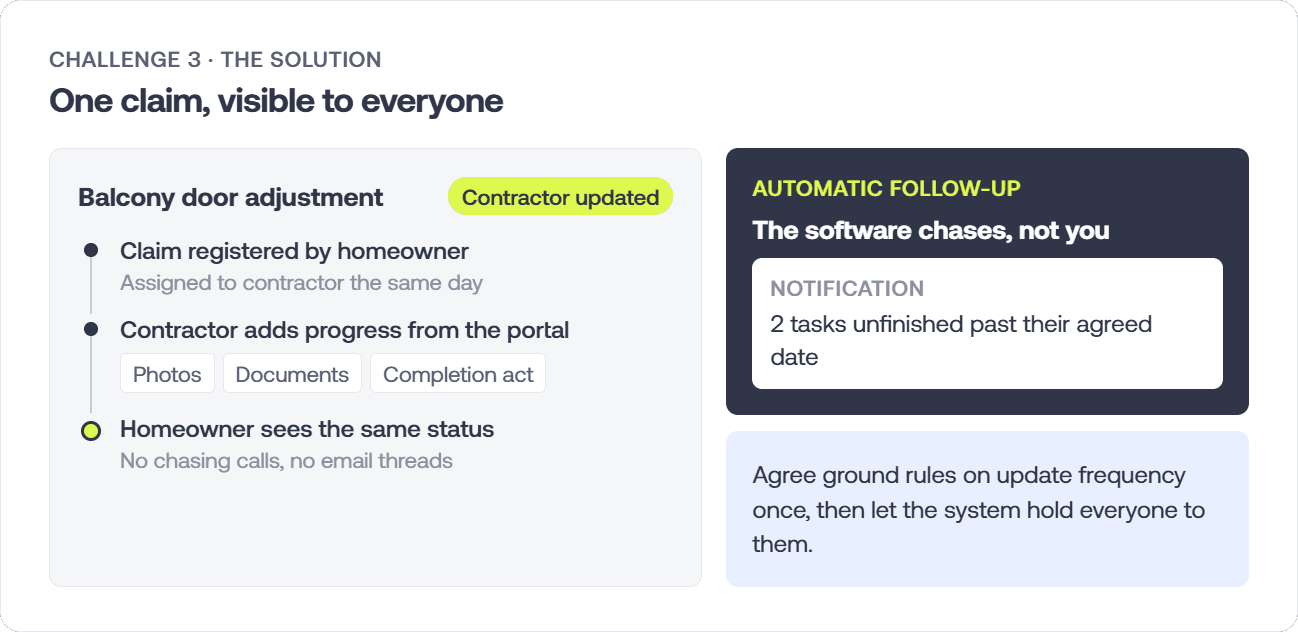
The third failure point is contractor silence. You cannot get operative information about ongoing tasks, so homeowners are left in the dark. Chasing progress by email is time-consuming and inefficient - it produces delays and miscommunication, and the lack of visibility steadily erodes the client's trust.
The solution: shared visibility plus automatic follow-up. Connect all parties in one system, agree on update-frequency ground rules, and let the software chase for you. Use Hausing to send notifications about unfinished tasks, making task management one step easier.
Contractors update their own tasks through a contractor portal, adding photos, documents and completion acts as they go.
What do these three challenges have in common?
Scattered information. Each is a symptom of warranty data living in inboxes, personal spreadsheets, and memory.
Get all parties into one system, and the deadlines, documents and progress updates largely take care of themselves. Estonian developers Kaamos Ehitus and Liven run their warranty operations on Hausing for exactly this reason.
"When all communication moves to one platform, many follow-up calls - like checking whether the work has already started - become unnecessary," explained Taavi Konga, Head of Construction at Liven.
Kaamos' former head of warranty and quality, Alex Talisainen, goes further: "I don't see any reason why a real estate developer today should still be using Excel." Read the Kaamos Ehitus case study.
See how Hausing brings warranty management and snagging into one system.
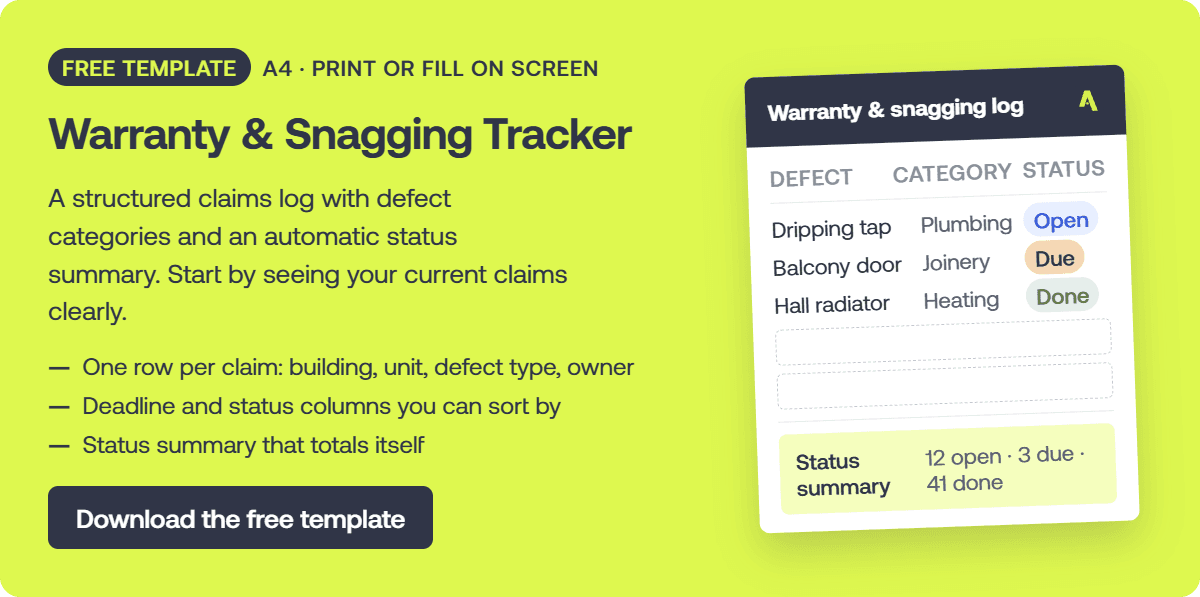
Start by seeing your current claims clearly: download the free Warranty & Snagging Tracker template - a structured claims log with defect categories and an automatic status summary.
Running warranty across multiple projects already? Book a call and see Hausing's warranty management live.
In this article / TLDR
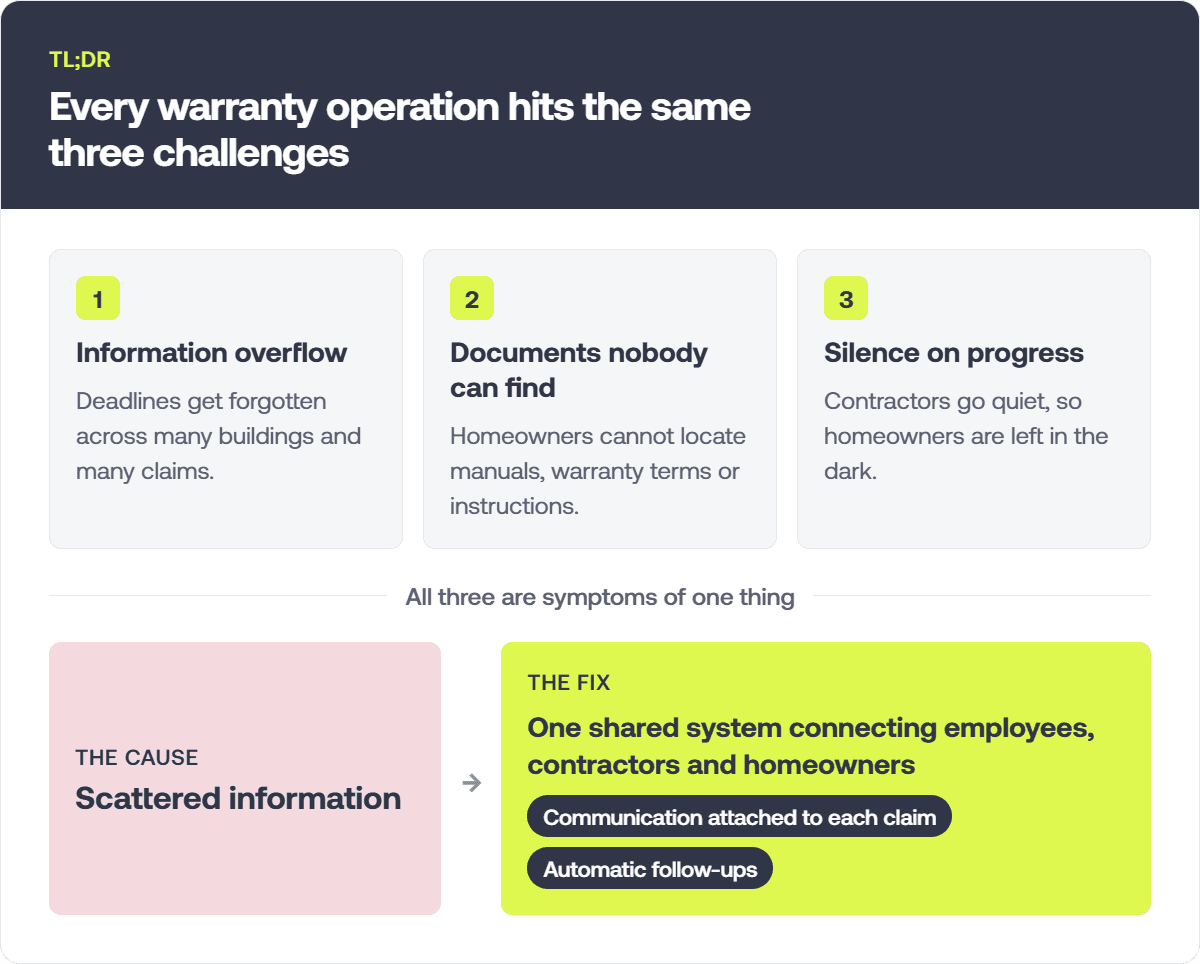
Every warranty operation hits the same 3 challenges: information overflow with forgotten deadlines, homeowners who cannot find important documents, and contractors who go silent on progress. All three are symptoms of scattered information - the fix is one shared system connecting employees, contractors and homeowners, with communication attached to each claim and automatic follow-ups.
Your download is ready
Thanks — here’s the full document. It’s yours to keep and share internally.
Related insights


Are you ready?
Centralize your property management workflows.
The 3 warranty management challenges every developer hits (and how to solve them)
News
•
Table of Contents
Be the first to know about our latest projects and news
A construction company typically provides a two-year warranty after handover. Homeowners can report problems as they appear, or collect them and report them near the end.
Either way, for the developer, those two years are an operational marathon: many buildings, any claims, many contractors, and a customer relationship that is decided by how smoothly it all runs.
The challenges look different from the homeowner's side and the developer's side, but the fix is shared: the developer has to build processes that are understandable and smooth for all parties.
Here are the three challenges that come up in almost every warranty operation, and how to solve each one.
Challenge 1: Information overflow and forgotten deadlines
Many buildings need tracking at the same time. Claims arrive by email, phone and in person. Each project manager keeps their own records.
The result is information overflow - and we all know what that means: things get forgotten or mixed up without a proper system. Forgotten deadlines and broken promises equal unhappy clients.
The solution: one system for everything.
Manage all warranty information on a single platform that connects your employees, contractors, and clients. There you can monitor warranty expiration dates, analyse incoming data and communicate with homeowners and contractors in one place.
Two details make the difference in practice.
First, keep communication attached to the claim - in Hausing, a chat function sits directly under the task that needs solving, so the information stays focused in one place. Even when work runs late, nothing earns a homeowner's patience like good communication.
Second, categorise everything by client, building and defect type. If you notice all the taps in a project are dripping, it may be time to change supplier before the next project - but you only see the pattern if the data is in one place.
Challenge 2: No easy access to important documents
Homeowners - especially first-time buyers - are often confused about the basics: which defects must the builder fix, and which problems are the homeowner's own responsibility? Where are the device manuals? What maintenance must the owner do themselves?
This confusion costs the developer directly: it produces non-warranty claims that consume your team's time, and neglected devices that fail earlier than they should. Well-maintained devices last much longer than neglected ones.
The solution: a proper handover pack, kept somewhere it can't get lost.
Challenge 3: No progress reports on ongoing tasks
The third failure point is contractor silence. You cannot get operative information about ongoing tasks, so homeowners are left in the dark. Chasing progress by email is time-consuming and inefficient - it produces delays and miscommunication, and the lack of visibility steadily erodes the client's trust.
The solution: shared visibility plus automatic follow-up. Connect all parties in one system, agree on update-frequency ground rules, and let the software chase for you. Use Hausing to send notifications about unfinished tasks, making task management one step easier.
Contractors update their own tasks through a contractor portal, adding photos, documents and completion acts as they go.
What do these three challenges have in common?
Scattered information. Each is a symptom of warranty data living in inboxes, personal spreadsheets, and memory.
Get all parties into one system, and the deadlines, documents and progress updates largely take care of themselves. Estonian developers Kaamos Ehitus and Liven run their warranty operations on Hausing for exactly this reason.
"When all communication moves to one platform, many follow-up calls - like checking whether the work has already started - become unnecessary," explained Taavi Konga, Head of Construction at Liven.
Kaamos' former head of warranty and quality, Alex Talisainen, goes further: "I don't see any reason why a real estate developer today should still be using Excel." Read the Kaamos Ehitus case study.
See how Hausing brings warranty management and snagging into one system.
Start by seeing your current claims clearly: download the free Warranty & Snagging Tracker template - a structured claims log with defect categories and an automatic status summary.
Running warranty across multiple projects already? Book a call and see Hausing's warranty management live.
In this article / TLDR
Every warranty operation hits the same 3 challenges: information overflow with forgotten deadlines, homeowners who cannot find important documents, and contractors who go silent on progress. All three are symptoms of scattered information - the fix is one shared system connecting employees, contractors and homeowners, with communication attached to each claim and automatic follow-ups.
Your download is ready
Thanks — here’s the full document. It’s yours to keep and share internally.
Related insights
Centralize your property management workflows.