Why does work order chaos hit shopping centres harder than any other property type?
News
•
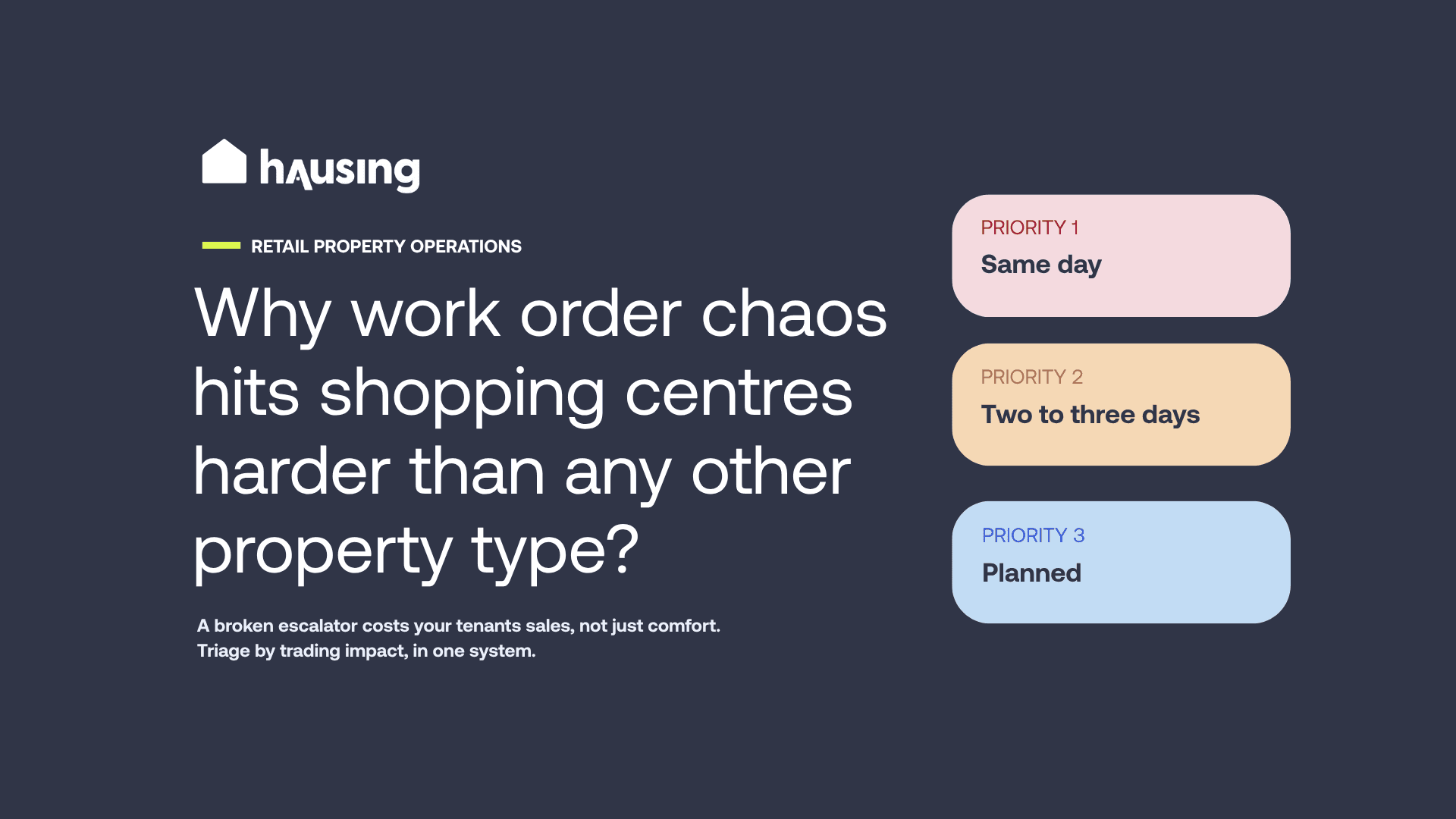
Table of Contents
Be the first to know about our latest projects and news
In an office building, a broken lift is an inconvenience. In a shopping centre, a broken escalator on the main customer route is a revenue event - for every tenant on the floor it serves.
That is what makes maintenance in retail property different. Your work orders are not just facility issues; each one has a trading impact attached, and your tenants feel it immediately in their tills.
Why is maintenance harder in a shopping centre than in other properties?
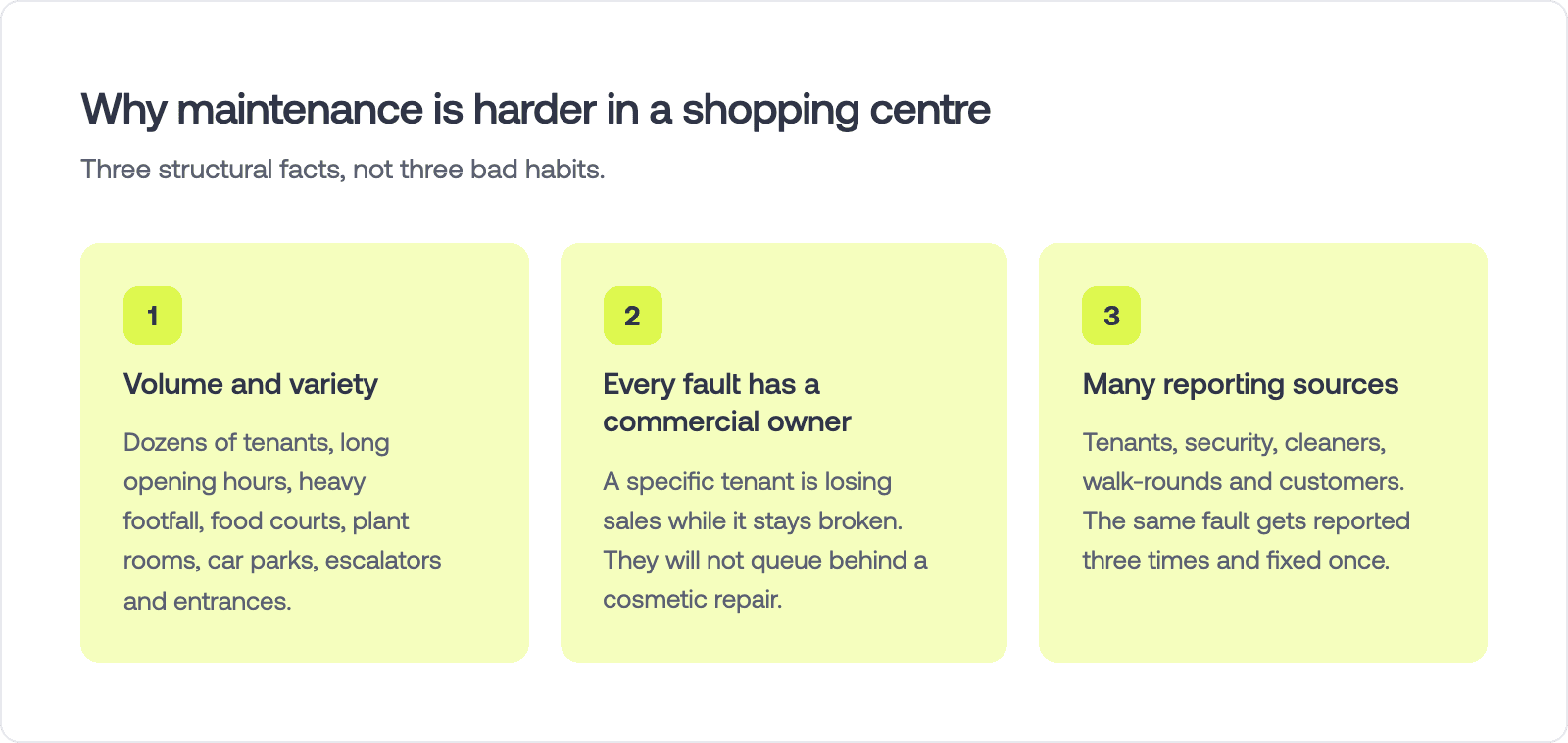
Three structural reasons:
Volume and variety. Dozens of tenants, long opening hours, heavy footfall, food courts, plant rooms, car parks, escalators and entrances - the sheer range of things that can fail is wider than in almost any other property type.
Every fault has a commercial owner. When something breaks, a specific tenant is losing sales or comfort while it stays broken. They will not wait patiently in a queue behind a cosmetic repair.
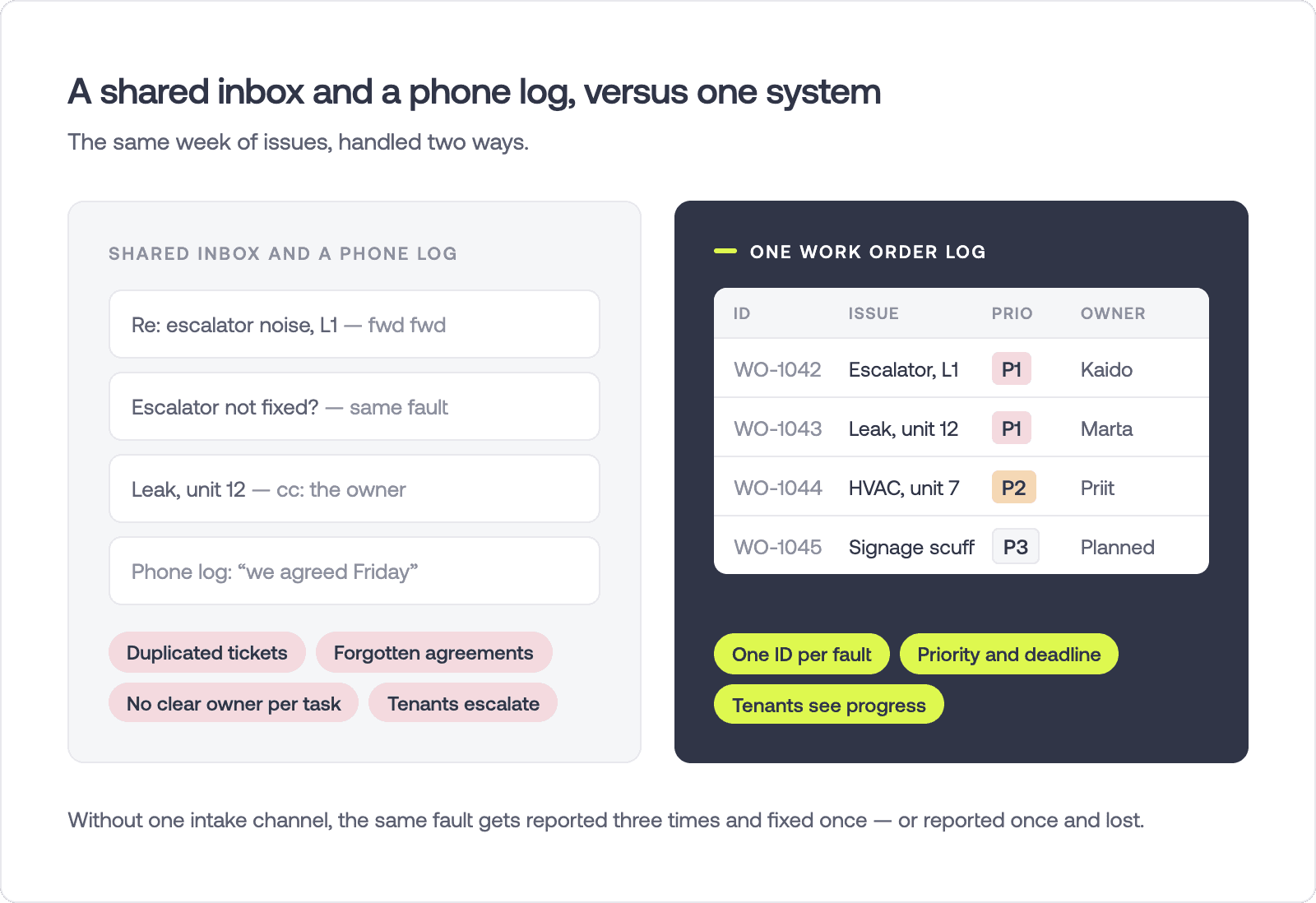
Many reporting sources. Issues come from tenants, security, cleaners, your own walk-rounds and customers. Without one intake channel, the same fault gets reported three times and fixed once - or reported once and lost.
What does work order chaos actually cost a shopping centre?
When requests live in a shared inbox and a phone log, the failure pattern is predictable: duplicated tickets, forgotten agreements, no clear owner per task, and no way to tell a tenant honestly where their issue stands.
Tenants respond by escalating - calling the centre manager directly, copying the owner into emails - which consumes exactly the management time that should go into running the centre.
And unhappy retail tenants do not just complain. They negotiate harder at renewal, dispute service charges with more energy, and tell other retailers about their experience.
Curious what this looks like from the tenant's side? See how Hausing improves the shopping centre tenant experience.
How should a shopping centre triage work orders?
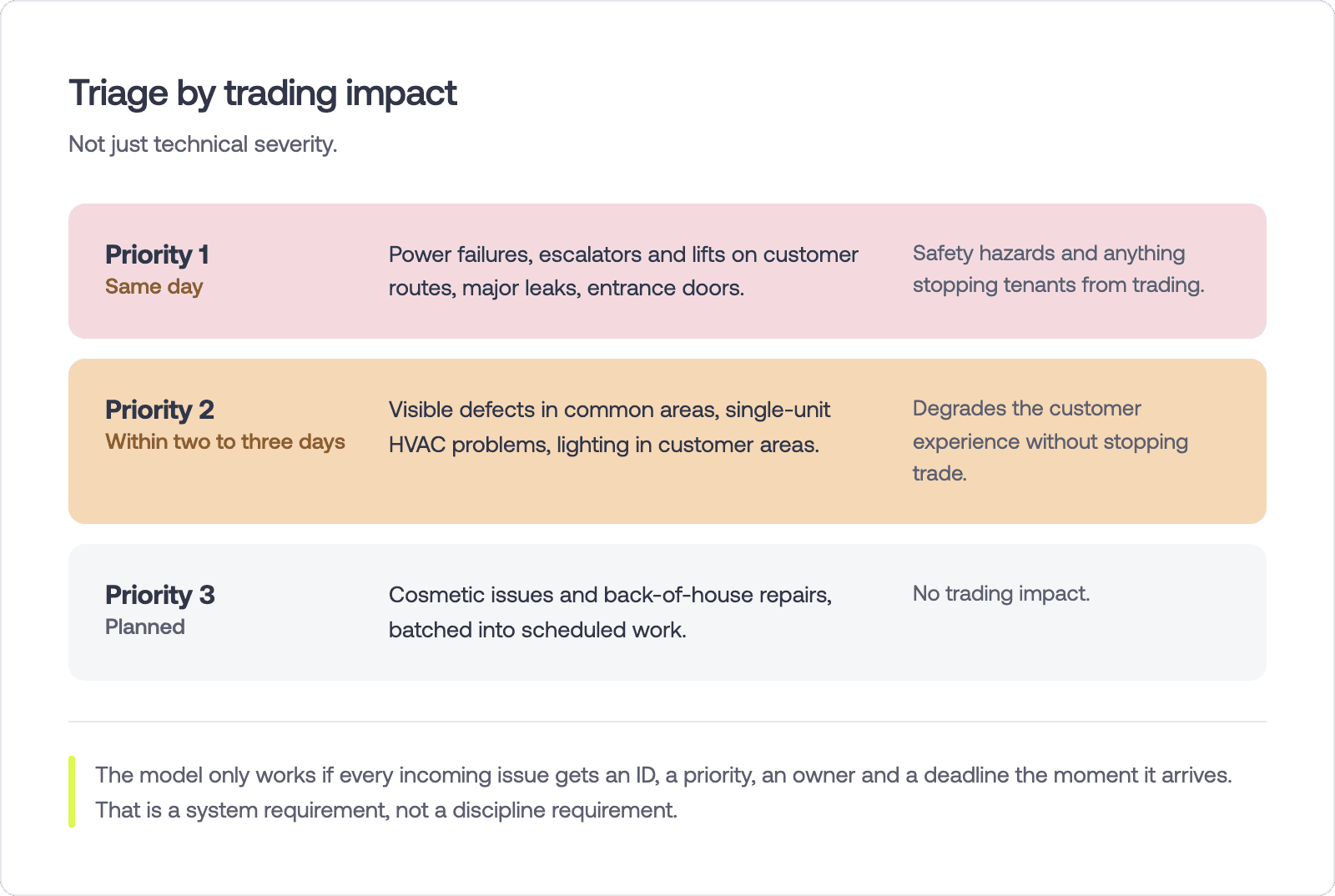
By trading impact, not just technical severity. A practical three-level model:
Priority | Response time | Examples |
|---|---|---|
Priority 1 | Same day | Safety hazards and anything stopping tenants from trading: power failures, escalators and lifts on customer routes, major leaks, entrance doors |
Priority 2 | Within two to three days | Visible defects in common areas, single-unit HVAC problems, lighting in customer areas - things that degrade the customer experience without stopping trade |
Priority 3 | Planned | Cosmetic issues and back-of-house repairs, batched into scheduled work |
The model only works if every incoming issue gets an ID, a priority, an owner and a deadline the moment it arrives. That is a system requirement, not a discipline requirement - no team can hold this in their heads at shopping centre volume.
What does a working system look like?
A working system gives every incoming issue four things the moment it arrives: an ID, a priority, an owner and a deadline, all visible in one place instead of scattered across inboxes and phone logs.
Hausing was built for exactly this class of problem: high-volume, multi-stakeholder maintenance. Every issue becomes a work order with a category, priority, assignee, deadline and status.
Tenants report through their own portal and see progress without calling you. Contractors work through a contractor portal, updating progress and adding photos, documents and completion acts against the task.
"What I like about Hausing is the 3-way communication between client, property manager and contractor, easy to add docs with drag'n'drop, delegating tasks, overview of all tickets." - Juris, Colliers
For proof the model holds at volume, look at Ülemiste City, the largest business campus in the Baltics. The campus processes around 800 work orders a month through Hausing - a multi-building, multi-tenant environment with the same core dynamics as a large centre. Across all customers, Hausing has created over 104,000 maintenance tickets.
Running maintenance across several retail sites rather than one centre? See how Hausing supports work order management for retail chains.
What should you do this week?
Put every incoming issue in one log, with a priority and an owner - even if that log starts as a spreadsheet.
Download the Retail Work Order Log template underneath the TL;DR section, and log one week of issues to know your real volumes, recurring categories, and how much of your team's day currently goes into being the system.
When the volume outgrows the spreadsheet, book a demo and see how the same log runs itself.
In this article / TLDR
In retail property, every maintenance fault has a trading impact - a broken escalator costs your tenants sales, not just comfort. Chaos comes from three structural facts: huge volume and variety, a commercial owner behind every fault, and many reporting sources. The fix is triage by trading impact (same day / two to three days / planned) plus one system where every issue gets an ID, priority, owner and deadline.
Your download is ready
Thanks — here’s the full document. It’s yours to keep and share internally.
Related insights


Are you ready?
Centralize your property management workflows.
Why does work order chaos hit shopping centres harder than any other property type?
News
•
Table of Contents
Be the first to know about our latest projects and news
In an office building, a broken lift is an inconvenience. In a shopping centre, a broken escalator on the main customer route is a revenue event - for every tenant on the floor it serves.
That is what makes maintenance in retail property different. Your work orders are not just facility issues; each one has a trading impact attached, and your tenants feel it immediately in their tills.
Why is maintenance harder in a shopping centre than in other properties?
Three structural reasons:
Volume and variety. Dozens of tenants, long opening hours, heavy footfall, food courts, plant rooms, car parks, escalators and entrances - the sheer range of things that can fail is wider than in almost any other property type.
Every fault has a commercial owner. When something breaks, a specific tenant is losing sales or comfort while it stays broken. They will not wait patiently in a queue behind a cosmetic repair.
Many reporting sources. Issues come from tenants, security, cleaners, your own walk-rounds and customers. Without one intake channel, the same fault gets reported three times and fixed once - or reported once and lost.
What does work order chaos actually cost a shopping centre?
When requests live in a shared inbox and a phone log, the failure pattern is predictable: duplicated tickets, forgotten agreements, no clear owner per task, and no way to tell a tenant honestly where their issue stands.
Tenants respond by escalating - calling the centre manager directly, copying the owner into emails - which consumes exactly the management time that should go into running the centre.
And unhappy retail tenants do not just complain. They negotiate harder at renewal, dispute service charges with more energy, and tell other retailers about their experience.
Curious what this looks like from the tenant's side? See how Hausing improves the shopping centre tenant experience.
How should a shopping centre triage work orders?
By trading impact, not just technical severity. A practical three-level model:
Priority | Response time | Examples |
|---|---|---|
Priority 1 | Same day | Safety hazards and anything stopping tenants from trading: power failures, escalators and lifts on customer routes, major leaks, entrance doors |
Priority 2 | Within two to three days | Visible defects in common areas, single-unit HVAC problems, lighting in customer areas - things that degrade the customer experience without stopping trade |
Priority 3 | Planned | Cosmetic issues and back-of-house repairs, batched into scheduled work |
The model only works if every incoming issue gets an ID, a priority, an owner and a deadline the moment it arrives. That is a system requirement, not a discipline requirement - no team can hold this in their heads at shopping centre volume.
What does a working system look like?
A working system gives every incoming issue four things the moment it arrives: an ID, a priority, an owner and a deadline, all visible in one place instead of scattered across inboxes and phone logs.
Hausing was built for exactly this class of problem: high-volume, multi-stakeholder maintenance. Every issue becomes a work order with a category, priority, assignee, deadline and status.
Tenants report through their own portal and see progress without calling you. Contractors work through a contractor portal, updating progress and adding photos, documents and completion acts against the task.
"What I like about Hausing is the 3-way communication between client, property manager and contractor, easy to add docs with drag'n'drop, delegating tasks, overview of all tickets." - Juris, Colliers
For proof the model holds at volume, look at Ülemiste City, the largest business campus in the Baltics. The campus processes around 800 work orders a month through Hausing - a multi-building, multi-tenant environment with the same core dynamics as a large centre. Across all customers, Hausing has created over 104,000 maintenance tickets.
Running maintenance across several retail sites rather than one centre? See how Hausing supports work order management for retail chains.
What should you do this week?
Put every incoming issue in one log, with a priority and an owner - even if that log starts as a spreadsheet.
Download the Retail Work Order Log template underneath the TL;DR section, and log one week of issues to know your real volumes, recurring categories, and how much of your team's day currently goes into being the system.
When the volume outgrows the spreadsheet, book a demo and see how the same log runs itself.
In this article / TLDR
In retail property, every maintenance fault has a trading impact - a broken escalator costs your tenants sales, not just comfort. Chaos comes from three structural facts: huge volume and variety, a commercial owner behind every fault, and many reporting sources. The fix is triage by trading impact (same day / two to three days / planned) plus one system where every issue gets an ID, priority, owner and deadline.
Your download is ready
Thanks — here’s the full document. It’s yours to keep and share internally.
Related insights
Centralize your property management workflows.