SINGU alternatives: six facility and property management platforms compared
News
•

Table of Contents
Be the first to know about our latest projects and news
What is SINGU, and what is it built for?
SINGU is a cloud CAFM and CMMS platform developed by Velis Real Estate Tech, based in Kraków. It is designed for facility, property and asset management of commercial and industrial real estate, combining maintenance operations with IoT sensor data, ESG reporting and analytics.
The platform is modular. Work orders, equipment data, preventive tasks, audits and vendor coordination sit in the core system, and Singu Tenant App is a separate product handling occupier communication, building files, announcements, surveys, maintenance requests and visitor pre-registration.
Velis states that the platform covers over 400 customers in 34 countries. Its centre of gravity is clear from the product design: large portfolios, professional FM teams, and owners who need consistent process across many sites.
That focus is a genuine strength. It is also the reason a mid-size owner sometimes finds the platform larger than the problem they are trying to solve.
Why do property teams look for a SINGU alternative?
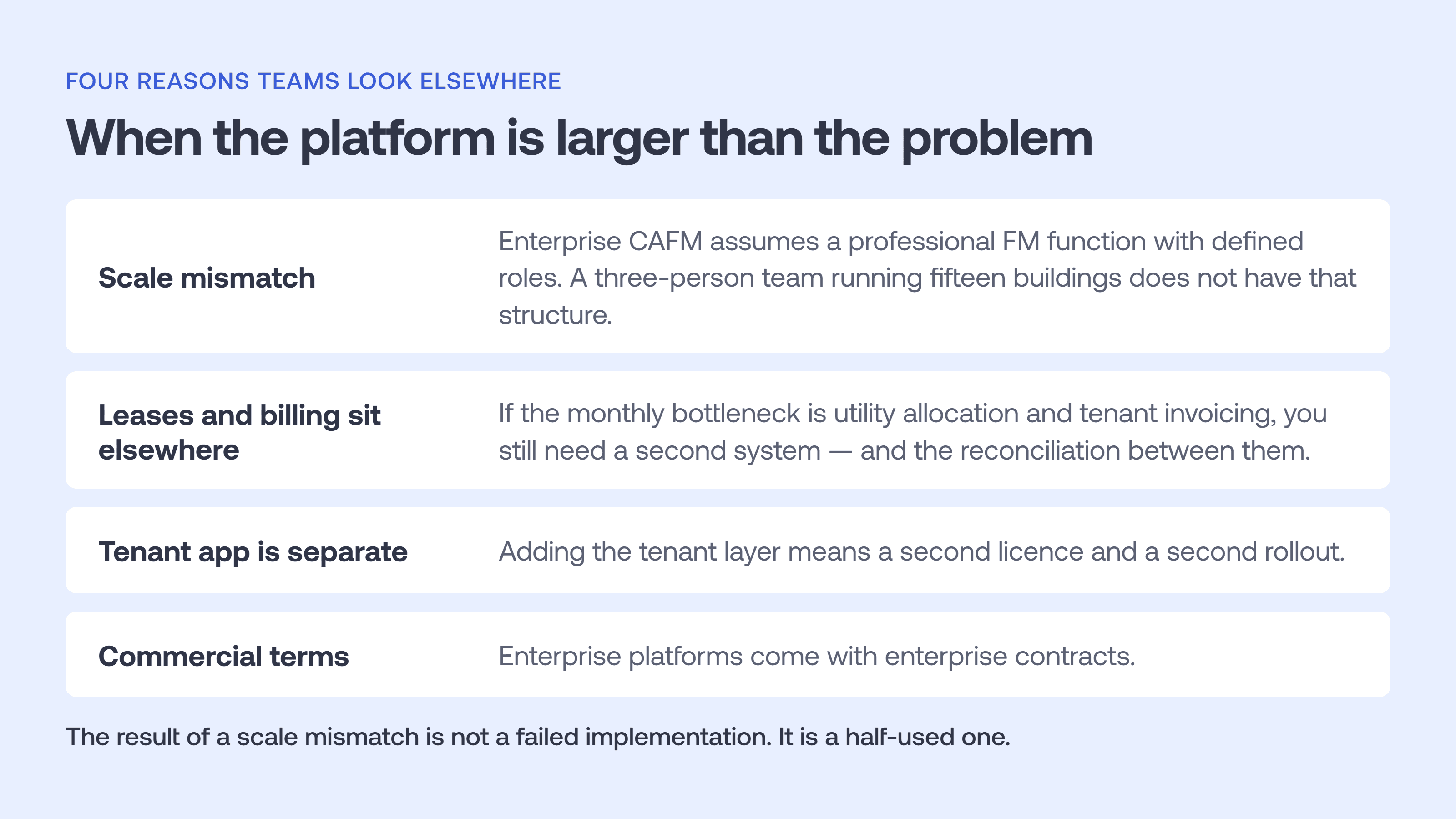
Four reasons account for most searches.
Scale mismatch. Enterprise CAFM assumes a professional facility management function with defined roles. A three-person property team running fifteen buildings does not have that structure, and the configuration effort assumes it does.
Leases and billing sit elsewhere. SINGU is built around facility operations. If your monthly bottleneck is utility cost allocation and tenant invoicing, you will still need a second system, and the reconciliation between them becomes its own admin job.
Tenant experience is a separate product. Adding the tenant layer means adding a second licence and a second rollout.
Commercial terms. Enterprise platforms come with enterprise contracts.
A scale mismatch doesn't mean a failed implementation. It is a half-used one: strong reporting on the sites that were configured properly, and everything else still running on email.
What should you compare when choosing a SINGU alternative?
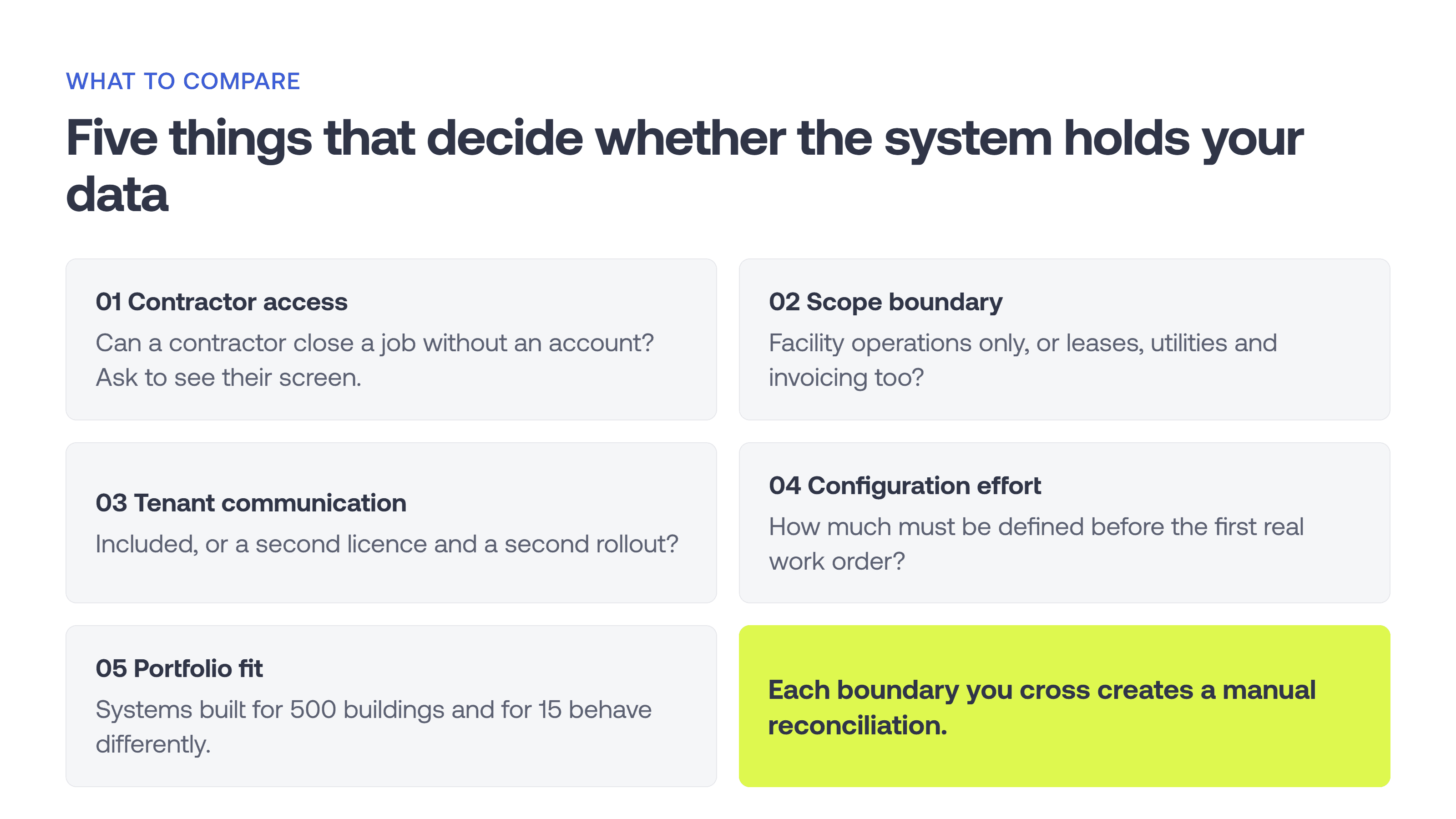
Compare the five things that determine whether the system will actually hold your data six months from now.
Contractor access. Can an external contractor receive, accept and close a job without an account? Every system claims contractor management. Ask to see the contractor's screen.
Scope boundary. Does the platform stop at facility operations, or does it also cover leases, service contracts, utility calculation and invoicing? Each boundary you cross creates a manual reconciliation.
Tenant communication. Is it included, or a separate licence?
Configuration effort before go-live. How much has to be defined before the first real work order can be logged?
Portfolio fit. Systems designed for 500 buildings and systems designed for 15 behave differently, and neither scales gracefully into the other's territory.
Which are the main SINGU alternatives?
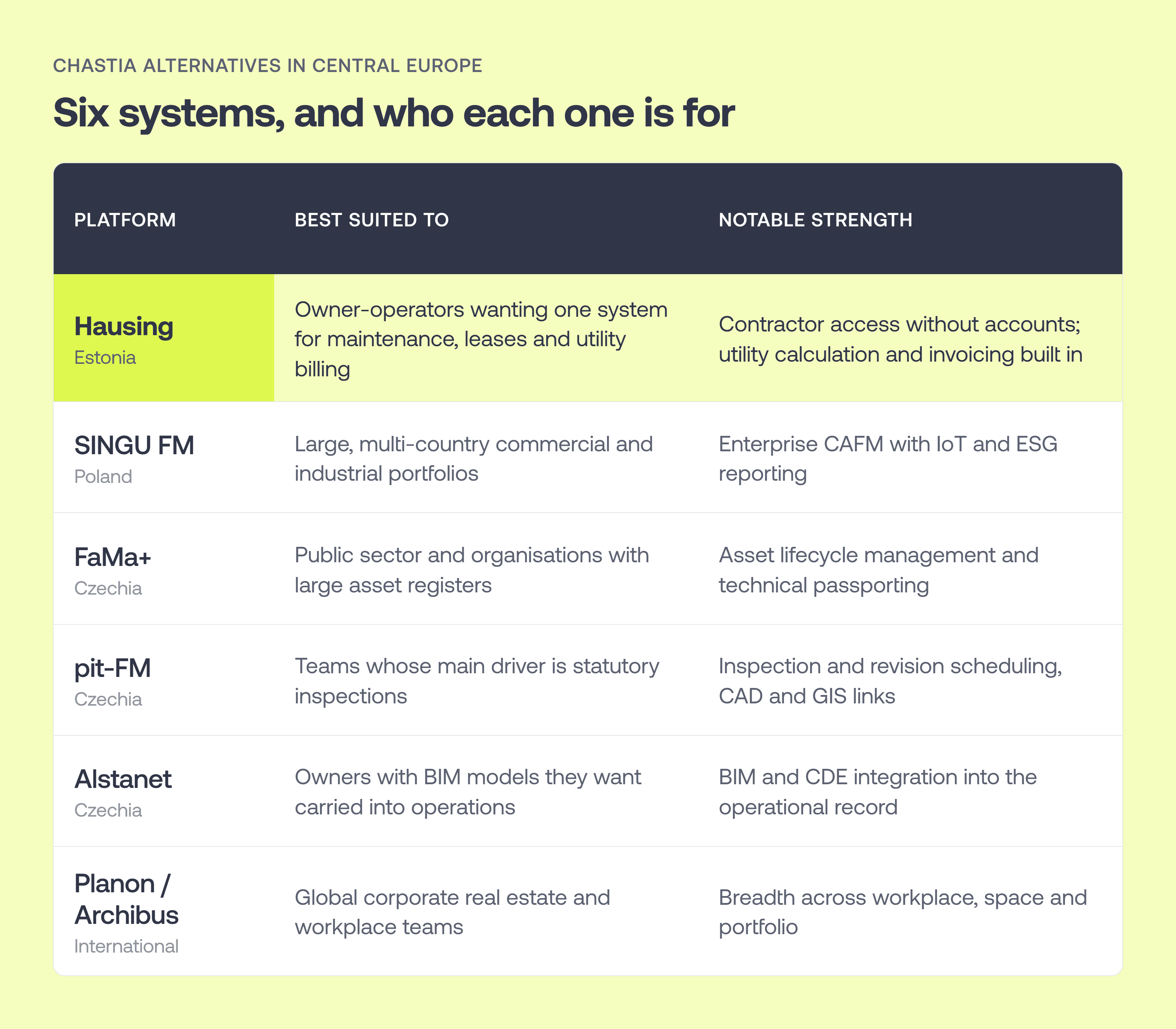
Platform | Origin | Best suited to | Notable strength |
Hausing | Estonia | Owner-operators and management companies with 5 to 100 buildings | Maintenance, leases and utility invoicing in one system; contractor access without accounts |
Chastia | Slovakia | Technical estates, energy-intensive assets, FM providers | Graphical technical passporting and energy cost allocation |
FaMa+ | Czechia | Public institutions and large asset registers | Asset lifecycle management with lease and technical passport modules |
pit-FM | Czechia | Maintenance and statutory inspection regimes | Revision and inspection scheduling, CAD and GIS links |
Planon / Archibus | International | Global corporate real estate and workplace teams | Breadth across workplace, space and portfolio |
Yardi / MRI | International | Institutional investors and fund-level reporting | Property accounting and investment reporting depth |
Hausing
Best for: commercial property owners, operators and management companies running roughly 5 to 100 buildings with a small in-house team.
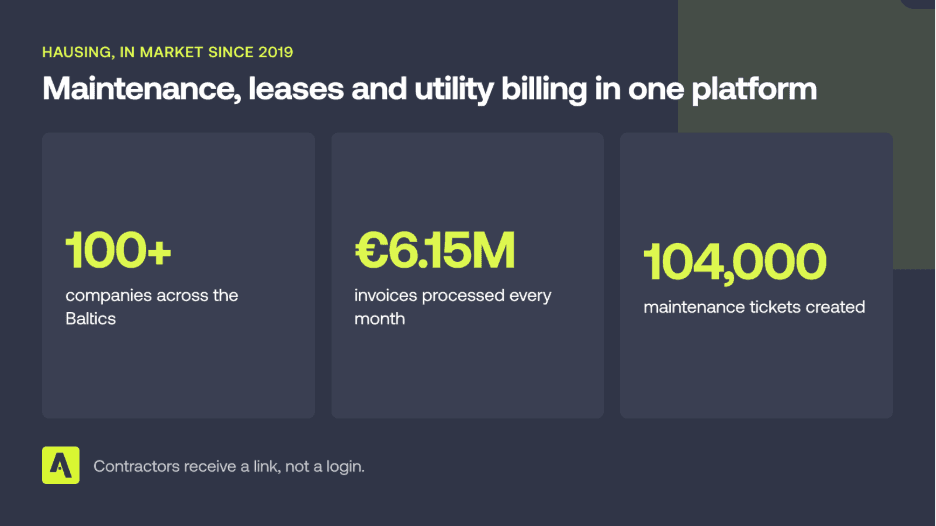
Hausing is a cloud commercial property management platform from Estonia, in market since 2019. It covers work orders and maintenance, preventive maintenance scheduling, inspections, lease and service contract management, utility cost calculation and invoicing, CRM, portfolio analytics, a tenant portal and accounting integrations. It works with over 100 companies across the Baltics, processes roughly €6.15 million in invoices monthly and has handled over 104,000 maintenance tickets.
The scope boundary is the main practical difference. Maintenance, leases and utility billing sit in the same platform rather than in two. Tulevara, a commercial real estate operator managing over 60,000 square metres in Estonia, chose it on exactly that basis. Board member Markus Jugala put it simply: "Hausing had the most features we wanted without requiring extensive additional development." They later added automated meter readings through an integration with Calidity. Read the Tulevara case study.
The second difference is contractor and portfolio scale-down. Windhorse Trust, a UK charity, manages 15 properties with a two-person team and has logged over 400 work orders with a 90 to 95 percent completion rate. Their maintenance manager Tejasiddhi describes the reason it stuck: "It's nice to have one thing rather than going to that spreadsheet, and that document, and that email." Read the Windhorse Trust case study.
Honest limitations: Hausing does not offer ESG reporting or IoT sensor management at the depth SINGU does, and it does not carry CAD or GIS drawing-based passporting. For a portfolio above roughly 200 buildings with a formal ESG reporting obligation, an enterprise CAFM platform will fit better.
Chastia
Best for: technical estates, energy-intensive assets and Slovak organisations that want a local vendor.
Chastia FM is a Slovak modular CAFM, CIFM and GIS system for recording, operating, maintaining and costing assets. Drawings are stored in the database itself, so you can search for every drawing containing a given area or piece of equipment. Its energy modules cover consumption records, energy and service budgeting and cost allocation, and the product line extends to Chastia ONE for helpdesk and Chastia IoT for data collection.
Compared with SINGU, it trades cloud-first convenience for graphical and energy depth, and it comes with Slovak implementation staff in Poprad, Košice and Bratislava.
FaMa+
Best for: public institutions and organisations with very large asset registers.
FaMa+ from Tesco SW joins the economic, technical and legal views of an asset in one lifecycle system. It includes a technical passport module for equipment with statutory activity planning, a lease relations module covering the rental process and vacant space, and the Rudy mobile app for technicians in the field, including offline use and voice or QR input.
pit-FM
Best for: organisations where statutory inspections and revisions drive the maintenance calendar.
pit-FM from pit Software covers passporting of sites, buildings, areas and building technical equipment, order and task management, contract management and CRM, with a reminder system for upcoming deadlines and two-way integration with CAD and GIS tools.
Planon and Archibus
Best for: global corporate real estate and workplace teams.
The international IWMS suites cover workplace, space, portfolio and maintenance more broadly than any regional vendor. They are also the heaviest and most expensive to implement, and are usually oversized for a single-country portfolio.
Yardi and MRI
Best for: institutional investors who need fund-level accounting and reporting.
These are property and investment management platforms first, with facility operations as a secondary layer. If your reporting obligations run upward to investors rather than outward to tenants and contractors, they solve a different problem than SINGU does. They are not a like-for-like replacement for a CAFM system.
When is SINGU still the right choice?
SINGU is the better answer in three situations.
If you manage a large multi-country portfolio and your core problem is process consistency across dozens or hundreds of sites, an enterprise CAFM platform is built for exactly that and lighter tools are not.
If ESG reporting is a formal obligation rather than an aspiration, SINGU's ESG and IoT capability is more developed than most regional alternatives.
If you have a professional in-house FM function with defined roles and the capacity to run a proper configuration project, you will get more out of a platform of this depth than out of a simpler one.
How do you test a shortlist without a six-month procurement cycle?
Test one building and one workflow across every candidate, and give the contractor's view equal weight to the manager's view.
A workable sequence:
Pick your most problematic building and your highest-volume job type.
Ask each vendor to demonstrate that exact job, end to end, including what the contractor sees and what the tenant sees.
Run one month-end process, ideally a utility calculation or an inspection with a signed report, in your two strongest candidates.
Ask one contractor and one tenant which experience they preferred.
The fourth step is the one most teams skip and the one that predicts adoption. At MyFitness, the Baltics' largest gym chain, some partners were initially sceptical, but that faded quickly. As administration specialist Clen Kink put it: "Once people take a moment to look into it, they all realise there's nothing difficult about Hausing." Read the MyFitness case study.
Frequently asked questions
What is the best alternative to SINGU?
It depends on portfolio size and scope. For owner-operators with roughly 5 to 100 buildings who also need leases and utility invoicing, Hausing is the closest fit. For technical or energy-intensive estates in Slovakia, Chastia offers graphical passporting and energy cost allocation SINGU does not match locally. For global corporate real estate, Planon or Archibus.
Is SINGU only for large portfolios?
Not exclusively, but the platform is designed around enterprise facility management practice, including IoT and ESG reporting. Smaller owners often find the configuration effort disproportionate to the problem they are solving.
Does a SINGU alternative need to include lease management?
Only if leases and utility billing are part of your monthly workload. If they are, keeping them in the same system as maintenance removes a reconciliation step. BLRT, an industrial holding managing more than 15,000 square metres, previously spent a full week each month on invoices and utility calculations in Excel before consolidating. Read the BLRT case study.
Will our contractors actually use a new system?
They will if you do not ask them to create an account. In Hausing, contractors receive a job by email with a link to a simplified view where they can see the task, add comments, upload photos and mark it complete, with no login required. The same design principle applies whichever platform you choose: measure contractor friction before you buy.
What happens when the person who runs our property management leaves?
That is the risk a shared system exists to remove. VAU Haldus, a property management company in Tallinn, describes the result of centralising: the entire history, day-to-day activities and overall pulse of each building live in one transparent system, so one manager's absence does not leave a building unsupervised. Read the VAU Haldus case study.
Does facility management software help with developer warranty work?
It can, but most CAFM platforms are not built for it. Kaamos Ehitus, an Estonian developer, consolidated warranty management out of scattered spreadsheets and a shared inbox. Work that previously required three project managers with Excel now needs two. Read the Kaamos Ehitus case study.
Ready to see how it works on one of your buildings?
If your work orders are spread across email and your utility calculation lives in a spreadsheet only one person understands, start with a single building and see how much of that admin disappears.
Try Hausing free and set up your first building this week.
Sources used
singu.com, velistech.com and Velis Real Estate Tech public materials
SINGU FM listings on Capterra and Google Play (module and feature descriptions)
chastia.com product and solutions pages; profesia.sk company profile
famaplus.cz and tescosw.cz
pitsoftware.cz
Hausing case studies, linked inline
In this article / TLDR
SINGU is an enterprise cloud CAFM and CMMS platform from Kraków, built for large commercial and industrial portfolios, with IoT integration, ESG reporting and a separate tenant app.
Teams look for alternatives mainly when the platform is larger than the problem, when leases and utility invoicing sit outside the system, or when the tenant experience is licensed separately.
The realistic alternatives are Hausing, Chastia, FaMa+, pit-FM, the international suites Planon and Archibus, and at the property accounting end, Yardi and MRI.
Feature lists rarely decide this. Contractor adoption does. If your external contractors will not use the system, no amount of dashboard sophistication will fix your data.
For portfolios of roughly 5 to 100 buildings run by a small in-house team, a platform that covers maintenance, leases and utility billing together usually beats a specialist FM system plus spreadsheets.
Related insights


Are you ready?
Centralize your property management workflows.
SINGU alternatives: six facility and property management platforms compared
News
•
Table of Contents
Be the first to know about our latest projects and news
What is SINGU, and what is it built for?
SINGU is a cloud CAFM and CMMS platform developed by Velis Real Estate Tech, based in Kraków. It is designed for facility, property and asset management of commercial and industrial real estate, combining maintenance operations with IoT sensor data, ESG reporting and analytics.
The platform is modular. Work orders, equipment data, preventive tasks, audits and vendor coordination sit in the core system, and Singu Tenant App is a separate product handling occupier communication, building files, announcements, surveys, maintenance requests and visitor pre-registration.
Velis states that the platform covers over 400 customers in 34 countries. Its centre of gravity is clear from the product design: large portfolios, professional FM teams, and owners who need consistent process across many sites.
That focus is a genuine strength. It is also the reason a mid-size owner sometimes finds the platform larger than the problem they are trying to solve.
Why do property teams look for a SINGU alternative?
Four reasons account for most searches.
Scale mismatch. Enterprise CAFM assumes a professional facility management function with defined roles. A three-person property team running fifteen buildings does not have that structure, and the configuration effort assumes it does.
Leases and billing sit elsewhere. SINGU is built around facility operations. If your monthly bottleneck is utility cost allocation and tenant invoicing, you will still need a second system, and the reconciliation between them becomes its own admin job.
Tenant experience is a separate product. Adding the tenant layer means adding a second licence and a second rollout.
Commercial terms. Enterprise platforms come with enterprise contracts.
A scale mismatch doesn't mean a failed implementation. It is a half-used one: strong reporting on the sites that were configured properly, and everything else still running on email.
What should you compare when choosing a SINGU alternative?
Compare the five things that determine whether the system will actually hold your data six months from now.
Contractor access. Can an external contractor receive, accept and close a job without an account? Every system claims contractor management. Ask to see the contractor's screen.
Scope boundary. Does the platform stop at facility operations, or does it also cover leases, service contracts, utility calculation and invoicing? Each boundary you cross creates a manual reconciliation.
Tenant communication. Is it included, or a separate licence?
Configuration effort before go-live. How much has to be defined before the first real work order can be logged?
Portfolio fit. Systems designed for 500 buildings and systems designed for 15 behave differently, and neither scales gracefully into the other's territory.
Which are the main SINGU alternatives?
Platform | Origin | Best suited to | Notable strength |
Hausing | Estonia | Owner-operators and management companies with 5 to 100 buildings | Maintenance, leases and utility invoicing in one system; contractor access without accounts |
Chastia | Slovakia | Technical estates, energy-intensive assets, FM providers | Graphical technical passporting and energy cost allocation |
FaMa+ | Czechia | Public institutions and large asset registers | Asset lifecycle management with lease and technical passport modules |
pit-FM | Czechia | Maintenance and statutory inspection regimes | Revision and inspection scheduling, CAD and GIS links |
Planon / Archibus | International | Global corporate real estate and workplace teams | Breadth across workplace, space and portfolio |
Yardi / MRI | International | Institutional investors and fund-level reporting | Property accounting and investment reporting depth |
Hausing
Best for: commercial property owners, operators and management companies running roughly 5 to 100 buildings with a small in-house team.
Hausing is a cloud commercial property management platform from Estonia, in market since 2019. It covers work orders and maintenance, preventive maintenance scheduling, inspections, lease and service contract management, utility cost calculation and invoicing, CRM, portfolio analytics, a tenant portal and accounting integrations. It works with over 100 companies across the Baltics, processes roughly €6.15 million in invoices monthly and has handled over 104,000 maintenance tickets.
The scope boundary is the main practical difference. Maintenance, leases and utility billing sit in the same platform rather than in two. Tulevara, a commercial real estate operator managing over 60,000 square metres in Estonia, chose it on exactly that basis. Board member Markus Jugala put it simply: "Hausing had the most features we wanted without requiring extensive additional development." They later added automated meter readings through an integration with Calidity. Read the Tulevara case study.
The second difference is contractor and portfolio scale-down. Windhorse Trust, a UK charity, manages 15 properties with a two-person team and has logged over 400 work orders with a 90 to 95 percent completion rate. Their maintenance manager Tejasiddhi describes the reason it stuck: "It's nice to have one thing rather than going to that spreadsheet, and that document, and that email." Read the Windhorse Trust case study.
Honest limitations: Hausing does not offer ESG reporting or IoT sensor management at the depth SINGU does, and it does not carry CAD or GIS drawing-based passporting. For a portfolio above roughly 200 buildings with a formal ESG reporting obligation, an enterprise CAFM platform will fit better.
Chastia
Best for: technical estates, energy-intensive assets and Slovak organisations that want a local vendor.
Chastia FM is a Slovak modular CAFM, CIFM and GIS system for recording, operating, maintaining and costing assets. Drawings are stored in the database itself, so you can search for every drawing containing a given area or piece of equipment. Its energy modules cover consumption records, energy and service budgeting and cost allocation, and the product line extends to Chastia ONE for helpdesk and Chastia IoT for data collection.
Compared with SINGU, it trades cloud-first convenience for graphical and energy depth, and it comes with Slovak implementation staff in Poprad, Košice and Bratislava.
FaMa+
Best for: public institutions and organisations with very large asset registers.
FaMa+ from Tesco SW joins the economic, technical and legal views of an asset in one lifecycle system. It includes a technical passport module for equipment with statutory activity planning, a lease relations module covering the rental process and vacant space, and the Rudy mobile app for technicians in the field, including offline use and voice or QR input.
pit-FM
Best for: organisations where statutory inspections and revisions drive the maintenance calendar.
pit-FM from pit Software covers passporting of sites, buildings, areas and building technical equipment, order and task management, contract management and CRM, with a reminder system for upcoming deadlines and two-way integration with CAD and GIS tools.
Planon and Archibus
Best for: global corporate real estate and workplace teams.
The international IWMS suites cover workplace, space, portfolio and maintenance more broadly than any regional vendor. They are also the heaviest and most expensive to implement, and are usually oversized for a single-country portfolio.
Yardi and MRI
Best for: institutional investors who need fund-level accounting and reporting.
These are property and investment management platforms first, with facility operations as a secondary layer. If your reporting obligations run upward to investors rather than outward to tenants and contractors, they solve a different problem than SINGU does. They are not a like-for-like replacement for a CAFM system.
When is SINGU still the right choice?
SINGU is the better answer in three situations.
If you manage a large multi-country portfolio and your core problem is process consistency across dozens or hundreds of sites, an enterprise CAFM platform is built for exactly that and lighter tools are not.
If ESG reporting is a formal obligation rather than an aspiration, SINGU's ESG and IoT capability is more developed than most regional alternatives.
If you have a professional in-house FM function with defined roles and the capacity to run a proper configuration project, you will get more out of a platform of this depth than out of a simpler one.
How do you test a shortlist without a six-month procurement cycle?
Test one building and one workflow across every candidate, and give the contractor's view equal weight to the manager's view.
A workable sequence:
Pick your most problematic building and your highest-volume job type.
Ask each vendor to demonstrate that exact job, end to end, including what the contractor sees and what the tenant sees.
Run one month-end process, ideally a utility calculation or an inspection with a signed report, in your two strongest candidates.
Ask one contractor and one tenant which experience they preferred.
The fourth step is the one most teams skip and the one that predicts adoption. At MyFitness, the Baltics' largest gym chain, some partners were initially sceptical, but that faded quickly. As administration specialist Clen Kink put it: "Once people take a moment to look into it, they all realise there's nothing difficult about Hausing." Read the MyFitness case study.
Frequently asked questions
What is the best alternative to SINGU?
It depends on portfolio size and scope. For owner-operators with roughly 5 to 100 buildings who also need leases and utility invoicing, Hausing is the closest fit. For technical or energy-intensive estates in Slovakia, Chastia offers graphical passporting and energy cost allocation SINGU does not match locally. For global corporate real estate, Planon or Archibus.
Is SINGU only for large portfolios?
Not exclusively, but the platform is designed around enterprise facility management practice, including IoT and ESG reporting. Smaller owners often find the configuration effort disproportionate to the problem they are solving.
Does a SINGU alternative need to include lease management?
Only if leases and utility billing are part of your monthly workload. If they are, keeping them in the same system as maintenance removes a reconciliation step. BLRT, an industrial holding managing more than 15,000 square metres, previously spent a full week each month on invoices and utility calculations in Excel before consolidating. Read the BLRT case study.
Will our contractors actually use a new system?
They will if you do not ask them to create an account. In Hausing, contractors receive a job by email with a link to a simplified view where they can see the task, add comments, upload photos and mark it complete, with no login required. The same design principle applies whichever platform you choose: measure contractor friction before you buy.
What happens when the person who runs our property management leaves?
That is the risk a shared system exists to remove. VAU Haldus, a property management company in Tallinn, describes the result of centralising: the entire history, day-to-day activities and overall pulse of each building live in one transparent system, so one manager's absence does not leave a building unsupervised. Read the VAU Haldus case study.
Does facility management software help with developer warranty work?
It can, but most CAFM platforms are not built for it. Kaamos Ehitus, an Estonian developer, consolidated warranty management out of scattered spreadsheets and a shared inbox. Work that previously required three project managers with Excel now needs two. Read the Kaamos Ehitus case study.
Ready to see how it works on one of your buildings?
If your work orders are spread across email and your utility calculation lives in a spreadsheet only one person understands, start with a single building and see how much of that admin disappears.
Try Hausing free and set up your first building this week.
Sources used
singu.com, velistech.com and Velis Real Estate Tech public materials
SINGU FM listings on Capterra and Google Play (module and feature descriptions)
chastia.com product and solutions pages; profesia.sk company profile
famaplus.cz and tescosw.cz
pitsoftware.cz
Hausing case studies, linked inline
In this article / TLDR
SINGU is an enterprise cloud CAFM and CMMS platform from Kraków, built for large commercial and industrial portfolios, with IoT integration, ESG reporting and a separate tenant app.
Teams look for alternatives mainly when the platform is larger than the problem, when leases and utility invoicing sit outside the system, or when the tenant experience is licensed separately.
The realistic alternatives are Hausing, Chastia, FaMa+, pit-FM, the international suites Planon and Archibus, and at the property accounting end, Yardi and MRI.
Feature lists rarely decide this. Contractor adoption does. If your external contractors will not use the system, no amount of dashboard sophistication will fix your data.
For portfolios of roughly 5 to 100 buildings run by a small in-house team, a platform that covers maintenance, leases and utility billing together usually beats a specialist FM system plus spreadsheets.
Related insights
Centralize your property management workflows.