What Is a building log and why does every property need one?
News
•

Table of Contents
Be the first to know about our latest projects and news
Every building accumulates a history: repairs, incidents, contractor visits, inspections, replaced devices, recurring faults.
That history is one of the most valuable operational assets you own - and in most portfolios, it lives in the worst possible place: individual inboxes.
What is a building log?
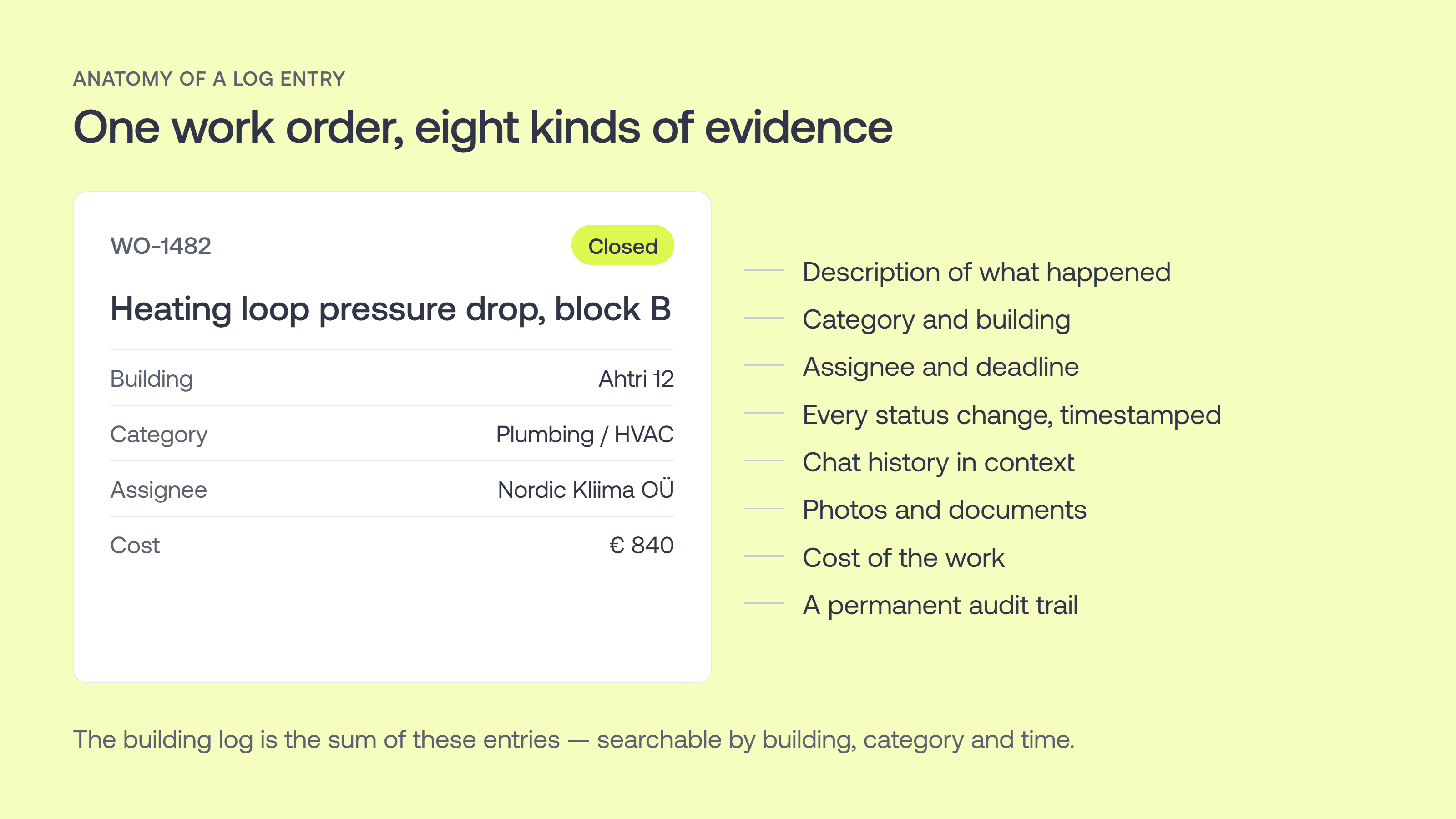
A building log is a single, permanent record of everything that has happened in a building: what broke, when, who fixed it, what it cost, and what documents or photos exist.
Think of it as the building's DNA - or its captain's log. When it is complete, anyone on your team can answer "what has happened here?" in seconds.
When it is incomplete, the answer depends on who you can still reach and what they can still remember.
Why does building history disappear?
Because it was never recorded or shared anywhere.
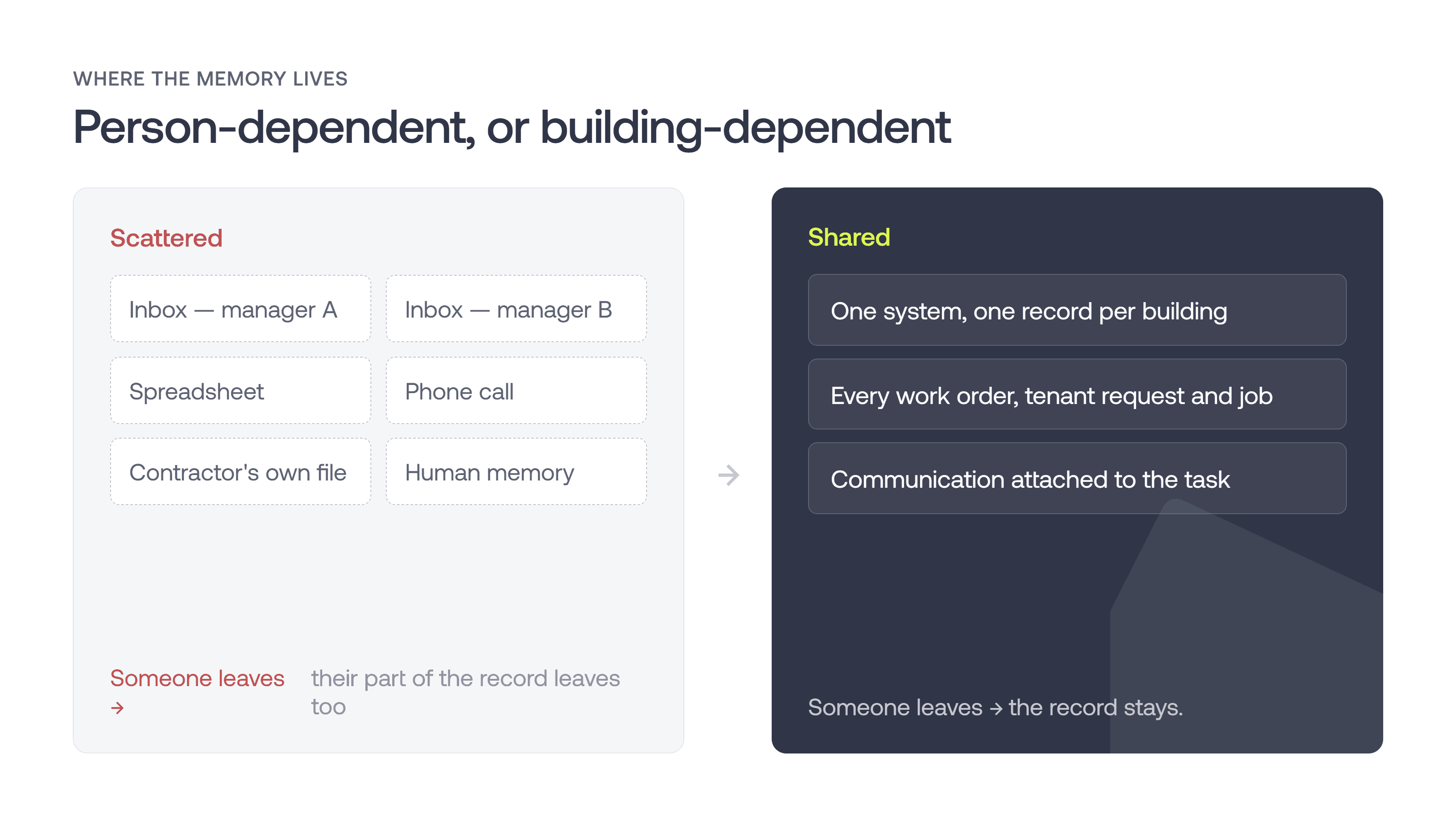
The typical pattern looks like this: each property manager tracks their own buildings their own way, agreements are made by email or phone, and the "record" is a mixture of inboxes, spreadsheets and human memory.
Then someone leaves, and their part of the building's memory leaves with them.
This is not hypothetical. At BLRT, the industrial holding whose property arm manages the Noblessner Port City district in Tallinn, the wake-up call came when the colleague responsible for leases and shared utility costs left her job. She had managed everything alone for years, and her systems were hard for anyone else to understand. The handover was overwhelming - and it made clear that the knowledge had been living in one person, not in the company.
Read the BLRT case study.
What does an incomplete building log cost you?
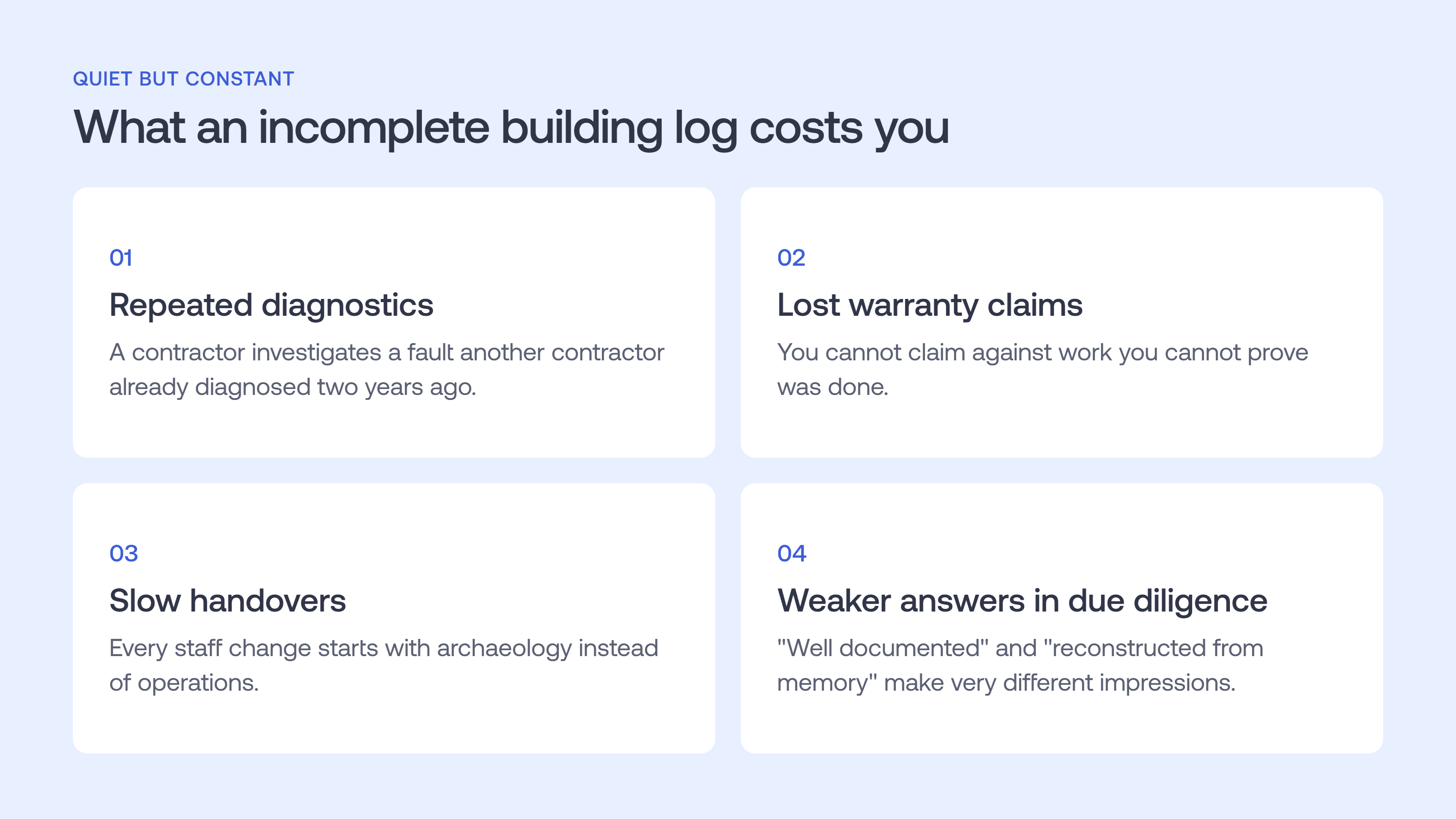
The costs are quiet but constant:
Repeated diagnostics. A contractor investigates a fault that a different contractor already diagnosed two years ago, because nobody can find the record.
Lost warranty and service claims. You cannot claim against work you cannot prove was done.
Slow handovers. Every staff change or management transition starts with archaeology instead of operations.
Weaker answers to owners and buyers. When an owner, valuer or prospective buyer asks about the building's maintenance history, "well documented" and "reconstructed from memory" make very different impressions. A complete, searchable history is easier to stand behind in any due diligence process.
How do you build a living building log?
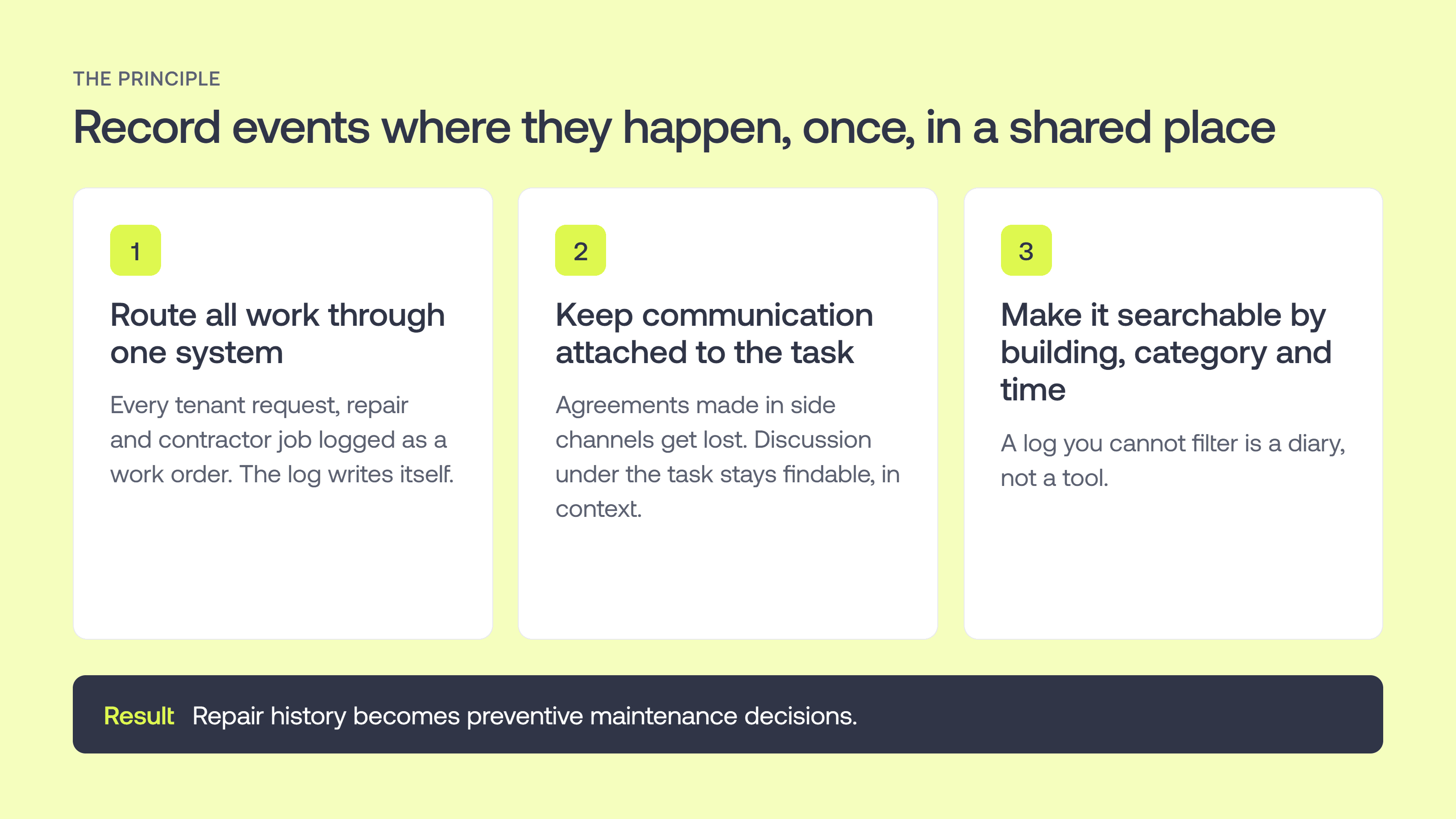
The principle is simple: record events where they happen, once, in a shared place.
Route all work through one system. If every tenant request, repair and contractor job is logged as a work order, your building log writes itself as a by-product of daily operations. In Hausing, every work order carries its description, category, assignee, deadline, status changes, chat history, photos and documents - a complete audit trail per task, built without anyone "doing documentation".
Keep communication attached to the task. Agreements made in side channels get lost. Discussion that happens in a chat under the specific task stays findable forever, in context.
Make it searchable by building, category and time. A log you cannot filter is a diary, not a tool. Categorised records let you see, for instance, every plumbing issue in one building over three years - which is exactly the view that turns repair history into preventive maintenance decisions.
This is what breaking the person-dependent model looks like in practice. Alex Talisainen, founder of Tallinn management company VAU Haldus, describes the result: "Thanks to Hausing, the entire history, day-to-day activities, and overall 'pulse' of each building now live in one transparent system. That keeps the service stable - one manager's holiday or sudden absence doesn't bring things to a halt or leave a building unsupervised." Read the VAU Haldus case study.
Windhorse Trust, a UK charity managing 15 properties, ran its version of this on spreadsheets, documents and email before consolidating everything into Hausing. Their manager's observation captures the risk of scattered records: when you have to look in several different places, there is always the potential for something to be missed.
See the fuller picture: Hausing for business campus property management.
Where should you start?
Start with a portfolio overview: your buildings, leases, contacts and a simple event log per building, in one structured document. Even in a spreadsheet, it beats inboxes.
Start your building's log this week. The free Property Portfolio Overview template includes a ready-made building log sheet - fill in one building and you'll see how much important data you've been keeping in inboxes.
Ready for a dedicated tool that keeps the log for you? Try Hausing for free or book a demo - we'll show you a building log that writes itself.
In this article / TLDR
Your building's history - repairs, faults, contractor visits, costs - is a valuable operational asset, and in most portfolios it lives in individual inboxes. When staff change, that memory leaves with them, costing you repeated diagnostics, lost warranty claims and weak answers in due diligence. The fix: route all work through one system so the log writes itself, keep communication attached to each task, and make it searchable by building, category and time.
Your download is ready
Thanks — here’s the full document. It’s yours to keep and share internally.
Related insights


Are you ready?
Centralize your property management workflows.
What Is a building log and why does every property need one?
News
•
Table of Contents
Be the first to know about our latest projects and news
Every building accumulates a history: repairs, incidents, contractor visits, inspections, replaced devices, recurring faults.
That history is one of the most valuable operational assets you own - and in most portfolios, it lives in the worst possible place: individual inboxes.
What is a building log?
A building log is a single, permanent record of everything that has happened in a building: what broke, when, who fixed it, what it cost, and what documents or photos exist.
Think of it as the building's DNA - or its captain's log. When it is complete, anyone on your team can answer "what has happened here?" in seconds.
When it is incomplete, the answer depends on who you can still reach and what they can still remember.
Why does building history disappear?
Because it was never recorded or shared anywhere.
The typical pattern looks like this: each property manager tracks their own buildings their own way, agreements are made by email or phone, and the "record" is a mixture of inboxes, spreadsheets and human memory.
Then someone leaves, and their part of the building's memory leaves with them.
This is not hypothetical. At BLRT, the industrial holding whose property arm manages the Noblessner Port City district in Tallinn, the wake-up call came when the colleague responsible for leases and shared utility costs left her job. She had managed everything alone for years, and her systems were hard for anyone else to understand. The handover was overwhelming - and it made clear that the knowledge had been living in one person, not in the company.
Read the BLRT case study.
What does an incomplete building log cost you?
The costs are quiet but constant:
Repeated diagnostics. A contractor investigates a fault that a different contractor already diagnosed two years ago, because nobody can find the record.
Lost warranty and service claims. You cannot claim against work you cannot prove was done.
Slow handovers. Every staff change or management transition starts with archaeology instead of operations.
Weaker answers to owners and buyers. When an owner, valuer or prospective buyer asks about the building's maintenance history, "well documented" and "reconstructed from memory" make very different impressions. A complete, searchable history is easier to stand behind in any due diligence process.
How do you build a living building log?
The principle is simple: record events where they happen, once, in a shared place.
Route all work through one system. If every tenant request, repair and contractor job is logged as a work order, your building log writes itself as a by-product of daily operations. In Hausing, every work order carries its description, category, assignee, deadline, status changes, chat history, photos and documents - a complete audit trail per task, built without anyone "doing documentation".
Keep communication attached to the task. Agreements made in side channels get lost. Discussion that happens in a chat under the specific task stays findable forever, in context.
Make it searchable by building, category and time. A log you cannot filter is a diary, not a tool. Categorised records let you see, for instance, every plumbing issue in one building over three years - which is exactly the view that turns repair history into preventive maintenance decisions.
This is what breaking the person-dependent model looks like in practice. Alex Talisainen, founder of Tallinn management company VAU Haldus, describes the result: "Thanks to Hausing, the entire history, day-to-day activities, and overall 'pulse' of each building now live in one transparent system. That keeps the service stable - one manager's holiday or sudden absence doesn't bring things to a halt or leave a building unsupervised." Read the VAU Haldus case study.
Windhorse Trust, a UK charity managing 15 properties, ran its version of this on spreadsheets, documents and email before consolidating everything into Hausing. Their manager's observation captures the risk of scattered records: when you have to look in several different places, there is always the potential for something to be missed.
See the fuller picture: Hausing for business campus property management.
Where should you start?
Start with a portfolio overview: your buildings, leases, contacts and a simple event log per building, in one structured document. Even in a spreadsheet, it beats inboxes.
Start your building's log this week. The free Property Portfolio Overview template includes a ready-made building log sheet - fill in one building and you'll see how much important data you've been keeping in inboxes.
Ready for a dedicated tool that keeps the log for you? Try Hausing for free or book a demo - we'll show you a building log that writes itself.
In this article / TLDR
Your building's history - repairs, faults, contractor visits, costs - is a valuable operational asset, and in most portfolios it lives in individual inboxes. When staff change, that memory leaves with them, costing you repeated diagnostics, lost warranty claims and weak answers in due diligence. The fix: route all work through one system so the log writes itself, keep communication attached to each task, and make it searchable by building, category and time.
Your download is ready
Thanks — here’s the full document. It’s yours to keep and share internally.
Related insights
Centralize your property management workflows.