Why warranty service is your best marketing channel
News
•

Table of Contents
Be the first to know about our latest projects and news
Ask a developer where their marketing budget goes, and they will point at campaigns, show flats and portals. Almost nobody points at the warranty department.
Yet for repeat purchases, the warranty period is the most powerful marketing channel a developer has - because it is where a buyer decides, over two full years, what your company is really like.
Why does warranty service drive future sales?
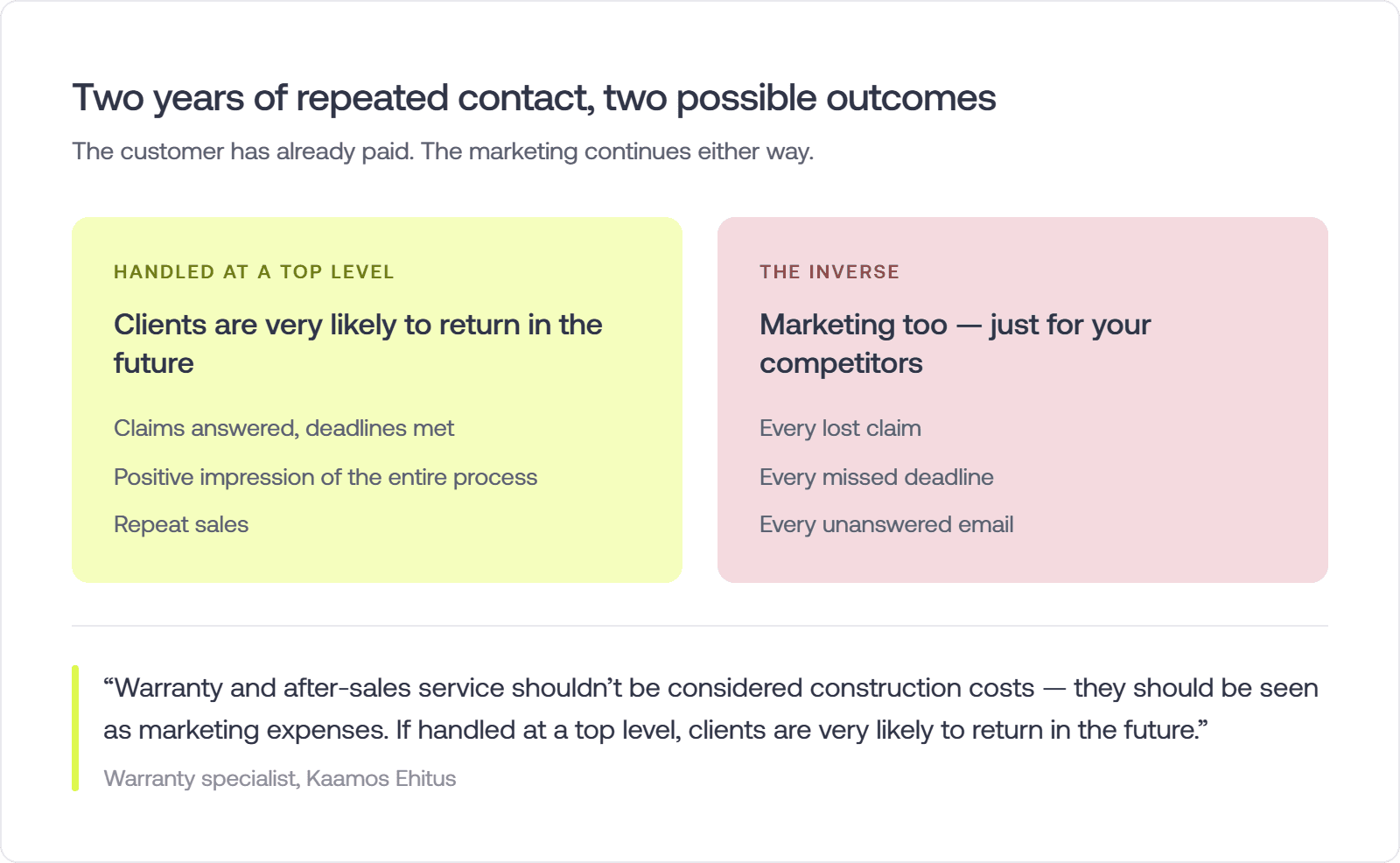
Because your most likely future buyer is a past buyer with a good experience. Someone who bought a home from you, and whose experience stayed positive from sale through after-sales, will very probably come back to you first when they next need property.
Estonian developer Kaamos Ehitus runs its after-sales on exactly this logic. The company is the builder behind the Avala business quarter, the Tammsaare business centre, and the Hõbemetsa and Vikimõisa residential districts.
Their warranty specialist frames it directly: "Warranty and after-sales service shouldn't be considered construction costs - they should be seen as marketing expenses. If handled at a top level, clients are very likely to return in the future."
Fellow Estonian developer Liven sees it the same way. "The client must also have a positive impression of the entire process. Service design is extremely important," emphasised Taavi Konga, Head of Construction at Liven.
The inverse is equally true. The warranty period is two years of repeated contact with a customer who has already paid. Every lost claim, missed deadline and unanswered email during that period is marketing too - just for your competitors.
What does the warranty period feel like for the buyer?

Usually: uncertain. From the homeowner's side, the recurring frustrations are well known.
They do not know how far along their submitted problems are - delayed responses and lack of transparency prolong everything. They struggle to tell which problems are warranty issues and which are their own responsibility. They're also often unsure what maintenance they are supposed to do themselves.
None of these frustrations requires a defect to exist. A developer can build flawlessly and still deliver a poor warranty experience purely through silence.
Why do developers struggle to deliver a good warranty experience?
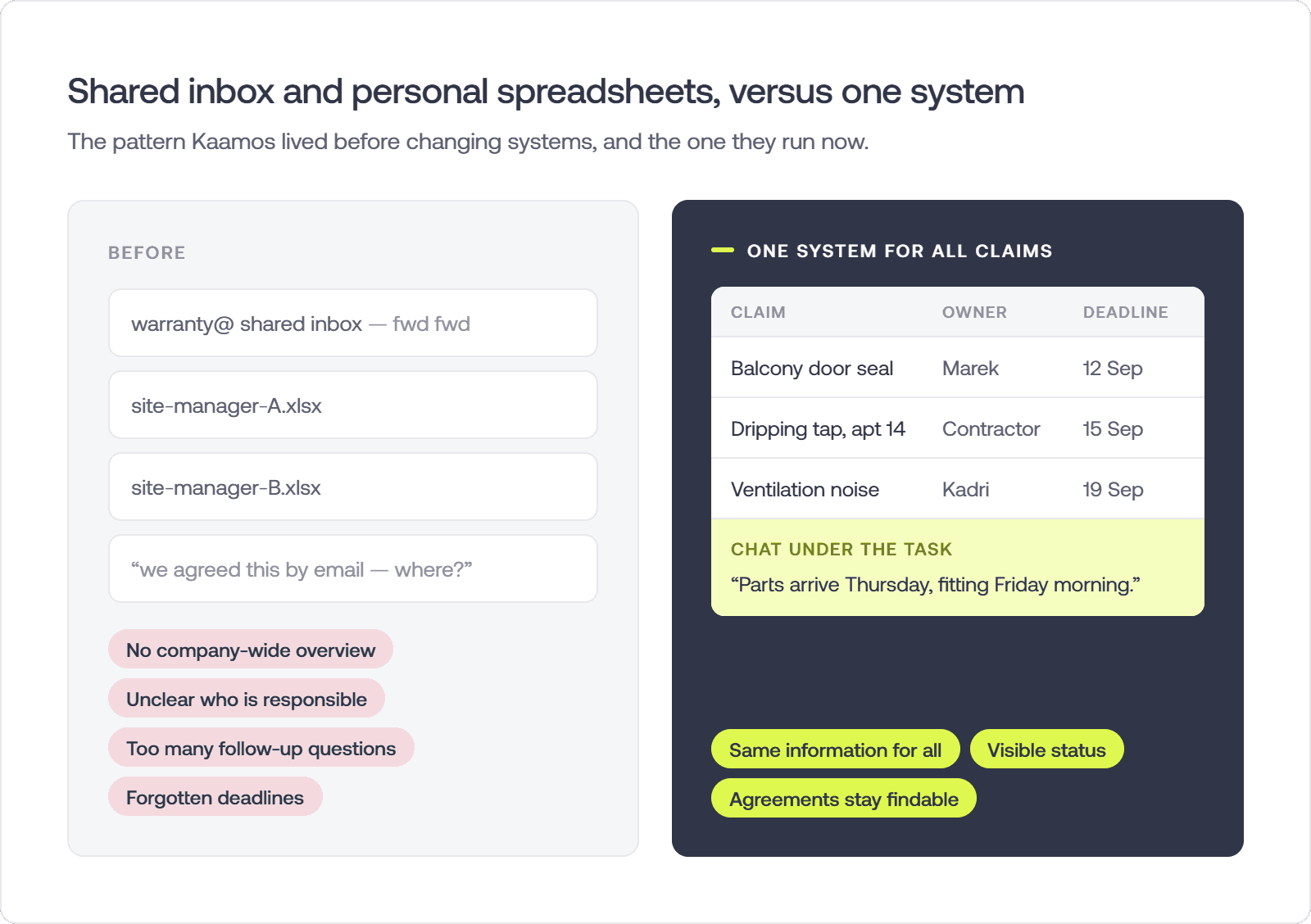
Because the operational reality behind warranty management is hard. Multiple buildings are under warranty at the same time, and claims arrive in a shared inbox. Each project manager tracks cases in their own spreadsheet, and agreements made by email later become hard to find.
Kaamos lived this pattern before changing systems. Every site manager had their own Excel file, so there was no proper company-wide overview - not even a reliable summary of typical defects.
All claims arrived at one shared warranty email address, where agreements tended to get lost, and it was unclear who was responsible for what. As their specialist put it, the main flaw of email-based claims handling is that it requires too many follow-up questions, which drags the whole process out.
Information overload creates the failure buyers remember: missed deadlines and broken promises. Forgotten deadlines equal unhappy clients - and unhappy clients equal lost repeat sales.
What does well-run warranty management look like?
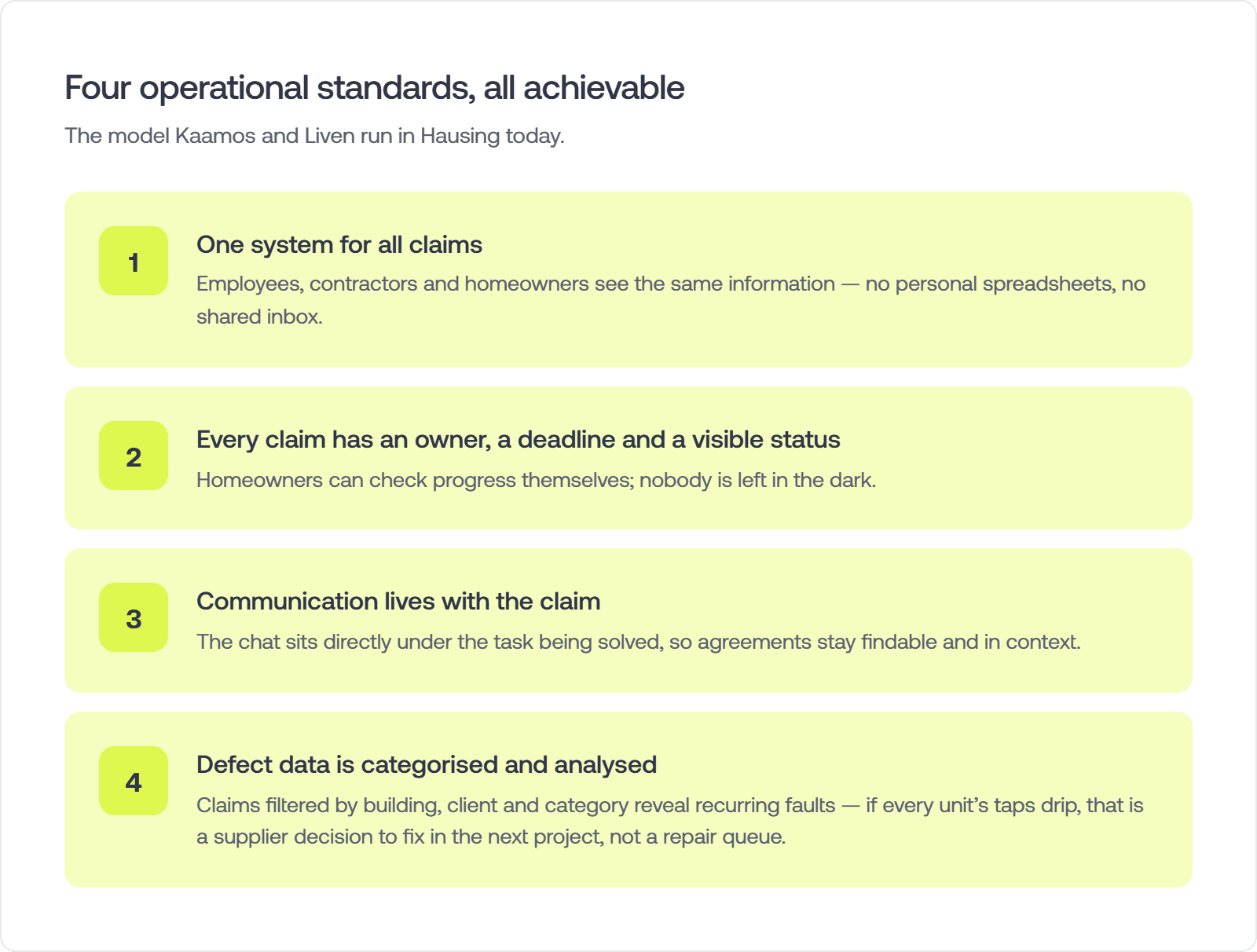
Four operational standards, all achievable:
One system for all claims, where employees, contractors and homeowners see the same information - no personal spreadsheets, no shared inbox.
Every claim has an owner, a deadline and a visible status. Homeowners can check progress themselves; nobody is left in the dark.
Communication lives with the claim. In Hausing, the chat sits directly under the task being solved, so agreements stay easy to find and in context. Even when work runs late, homeowners appreciate clear communication most.
Defect data is categorised and analysed. Claims filtered by building, client and category reveal recurring faults - if every unit's taps drip, that is a supplier decision to fix in the next project, not a repair queue.
This is the model Kaamos and Liven run in Hausing today for their warranty operations.
See how Hausing supports warranty management and snagging for residential developers.
Where should you start?
Measure your current state with one question: could you produce, within an hour, a list of every open warranty claim across all projects, with owners and deadlines? If not, the system is the gap. But the buyer's experience starts earlier than the first claim - it starts on handover day, with what you put in their hands.
Download the free Homeowner Handover Pack Checklist underneath the TL;DR section; it includes the nine things every buyer should receive, plus a fill-in table of their own maintenance duties.
Want the full story of a developer who rebuilt this end-to-end? Read the Kaamos Ehitus and Liven case studies.
Ready to turn your warranty period into a marketing channel? Book a short demo and see Hausing's warranty management live.
In this article / TLDR
Your most likely future buyer is a past buyer with a good experience - which makes the two-year warranty period your most powerful marketing channel. Buyers mostly suffer from silence, not defects: unclear status, unclear responsibilities, unclear maintenance duties. Well-run warranty management means one system for all claims, an owner and deadline per claim, communication attached to the task, and categorised defect data.
Your download is ready
Thanks — here’s the full document. It’s yours to keep and share internally.
Related insights


Are you ready?
Centralize your property management workflows.
Why warranty service is your best marketing channel
News
•
Table of Contents
Be the first to know about our latest projects and news
Ask a developer where their marketing budget goes, and they will point at campaigns, show flats and portals. Almost nobody points at the warranty department.
Yet for repeat purchases, the warranty period is the most powerful marketing channel a developer has - because it is where a buyer decides, over two full years, what your company is really like.
Why does warranty service drive future sales?
Because your most likely future buyer is a past buyer with a good experience. Someone who bought a home from you, and whose experience stayed positive from sale through after-sales, will very probably come back to you first when they next need property.
Estonian developer Kaamos Ehitus runs its after-sales on exactly this logic. The company is the builder behind the Avala business quarter, the Tammsaare business centre, and the Hõbemetsa and Vikimõisa residential districts.
Their warranty specialist frames it directly: "Warranty and after-sales service shouldn't be considered construction costs - they should be seen as marketing expenses. If handled at a top level, clients are very likely to return in the future."
Fellow Estonian developer Liven sees it the same way. "The client must also have a positive impression of the entire process. Service design is extremely important," emphasised Taavi Konga, Head of Construction at Liven.
The inverse is equally true. The warranty period is two years of repeated contact with a customer who has already paid. Every lost claim, missed deadline and unanswered email during that period is marketing too - just for your competitors.
What does the warranty period feel like for the buyer?
Usually: uncertain. From the homeowner's side, the recurring frustrations are well known.
They do not know how far along their submitted problems are - delayed responses and lack of transparency prolong everything. They struggle to tell which problems are warranty issues and which are their own responsibility. They're also often unsure what maintenance they are supposed to do themselves.
None of these frustrations requires a defect to exist. A developer can build flawlessly and still deliver a poor warranty experience purely through silence.
Why do developers struggle to deliver a good warranty experience?
Because the operational reality behind warranty management is hard. Multiple buildings are under warranty at the same time, and claims arrive in a shared inbox. Each project manager tracks cases in their own spreadsheet, and agreements made by email later become hard to find.
Kaamos lived this pattern before changing systems. Every site manager had their own Excel file, so there was no proper company-wide overview - not even a reliable summary of typical defects.
All claims arrived at one shared warranty email address, where agreements tended to get lost, and it was unclear who was responsible for what. As their specialist put it, the main flaw of email-based claims handling is that it requires too many follow-up questions, which drags the whole process out.
Information overload creates the failure buyers remember: missed deadlines and broken promises. Forgotten deadlines equal unhappy clients - and unhappy clients equal lost repeat sales.
What does well-run warranty management look like?
Four operational standards, all achievable:
One system for all claims, where employees, contractors and homeowners see the same information - no personal spreadsheets, no shared inbox.
Every claim has an owner, a deadline and a visible status. Homeowners can check progress themselves; nobody is left in the dark.
Communication lives with the claim. In Hausing, the chat sits directly under the task being solved, so agreements stay easy to find and in context. Even when work runs late, homeowners appreciate clear communication most.
Defect data is categorised and analysed. Claims filtered by building, client and category reveal recurring faults - if every unit's taps drip, that is a supplier decision to fix in the next project, not a repair queue.
This is the model Kaamos and Liven run in Hausing today for their warranty operations.
See how Hausing supports warranty management and snagging for residential developers.
Where should you start?
Measure your current state with one question: could you produce, within an hour, a list of every open warranty claim across all projects, with owners and deadlines? If not, the system is the gap. But the buyer's experience starts earlier than the first claim - it starts on handover day, with what you put in their hands.
Download the free Homeowner Handover Pack Checklist underneath the TL;DR section; it includes the nine things every buyer should receive, plus a fill-in table of their own maintenance duties.
Want the full story of a developer who rebuilt this end-to-end? Read the Kaamos Ehitus and Liven case studies.
Ready to turn your warranty period into a marketing channel? Book a short demo and see Hausing's warranty management live.
In this article / TLDR
Your most likely future buyer is a past buyer with a good experience - which makes the two-year warranty period your most powerful marketing channel. Buyers mostly suffer from silence, not defects: unclear status, unclear responsibilities, unclear maintenance duties. Well-run warranty management means one system for all claims, an owner and deadline per claim, communication attached to the task, and categorised defect data.
Your download is ready
Thanks — here’s the full document. It’s yours to keep and share internally.
Related insights
Centralize your property management workflows.